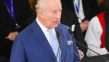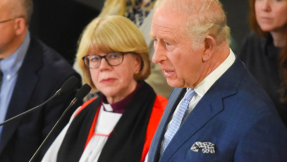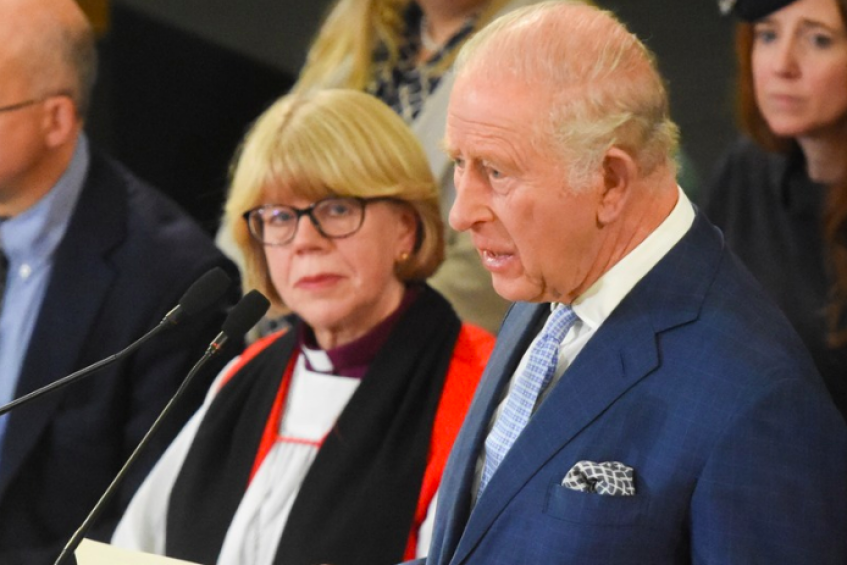
Both King Charles and the Church of England’s General Synod have given every appearance of being pleased with themselves after he gave what appeared to be an emollient address at the opening of the new session of the Synod.
In terms of a philosophy of being nice to others, his speech scored highly. He appeared to be saying nice things to nice people, promising nice outcomes. He told them that the Church protects “the very space for faith itself - of every belief” within our society.
The difficulty was that this bore very little connection to the reality of the situation as Christianity struggles in this country in 2026.
Obviously, those who helped him compose the speech were thinking back to a speech delivered by his mother at Lambeth Palace in 2012, nearly 15 years ago.
She said, to much applause, “The Church has a duty to protect the free practice of all faiths in this country.”
Many people applauded Queen Elizabeth II for what appeared to be her responsible generosity, but in fact the established Church, in its legal form, is a creation of Parliament, and Parliament is under no obligation to pay any attention to what the Church says. In fact, it hardly ever has done so. It rejected the Church’s revised Prayer Book in 1927 and again in 1928. It is not about to start now.
So even then it sounded more impressive than it actually was. It had very little cash value at the time, but once again it was good for the PR image of both the monarchy and the C of E.
But everything has changed since then.
There are two serious problems with what King Charles said. One is theological and the other is political.
The theological problem is that there is no way at all that Jesus would have endorsed the faded liberal generosity of keeping a free space for everyone to practise whatever religion they wanted.
The life of Jesus took place under an authoritarian pagan empire in which freedom was not a currency with any purchasing power at the time.
Nor did freedom to practise your religion have anything to do with Jewish culture as it had evolved under the influence of the Law and the Prophets.
If we take the prophets seriously, none of them were remotely interested in the rights of other religions to lead people astray from the one true God.
This idea of everyone having the space to seek their own way is the tail end of a disastrous liberal experiment in Western culture. It plays well to faded liberal consciences, but it means very little and it is entirely inconsistent with both Judaism and Christianity.
But let’s go to the second objection, which is equally important and concerns the political dimension.
What has changed since 2012?
First of all, the myth of the safe, neutral public square has been demolished forever.
It never was the case that the public square was neutral towards Christianity. Certainly, since the 1960s, it has operated as a competing moral authority, complete with its own assumptions about human identity, sexuality, freedom, equality and the nature of the good, all of which have differed from Christian assumptions.
Slowly but surely, Christian morals have been sidelined to the point of extinction, and we have to say that we’ve now come to the point where they are being criminalised.
It is hard to credit that the King could stand up and say that the Church of England and the state together shared a duty to create a safe space for religious inquiry.
The King’s state prosecuted Isabel Vaughan-Spruce.
Her experiences outside abortion facilities in Birmingham have exposed one of the most sinister and threatening developments in the relationship between the British state and the Christian conscience.
The King’s police force is now entitled to ask someone standing on the pavement what they are thinking about as a prelude to arresting them.
It’s true that after they were challenged, she was cleared and in 2024 received a £13,000 settlement following legal action against the police, but the police haven’t given up. They went on pursuing her, charging her with silent prayer outside abortion facilities, and once again she’s being brought to trial. This time she has been charged under the Public Order Act 2023. She is the first person to be prosecuted under the national buffer zone law and faces five charges. Her trial is set for 25 to 29 January 2027.
Vaughan-Spruce’s case on its own makes the King’s statement look somewhere between out of touch and malevolent, with stupid somewhere in between. If we take the most charitable view, that he is ignorant, such ignorance is unforgivable in the face of the persecution not only of Christians but also of those who take refuge in their consciences in the UK in 2026.
But of course it doesn’t end there
Adam Smith-Connor, the former soldier convicted in October 2024 after praying silently within a Bournemouth abortion clinic buffer zone, is another example. His prayer concerned his own pre-born son, whose abortion he deeply regretted. He was given a conditional discharge and ordered to pay £9,000 in prosecution costs.
It is offensive to talk about Britain being a neutral space where people can pursue their spiritual journeys and consciences when silent prayer becomes a matter for arrest and prosecution.
What would the King have said if Felix Ngole had been standing in front of him or in the spectators’ gallery of Church House?
As a Christian social work student, he successfully challenged Sheffield University’s decision to remove him from his social work course following his expression of traditional Christian beliefs about sexuality on social media.
A few years later, in 2022, he found himself involved in another dispute with a prospective employer, a Leeds mental health charity, which withdrew a job offer after discovering his Christian history. A tribunal in 2024 found that withdrawing the offer was discrimination but rejected the rest of his claim. This year, the Employment Appeal Tribunal overturned parts of that ruling and found that the charity had discriminated against him because of his Christian beliefs.
Christians are increasingly required not just to demonstrate professional competence and fair treatment of others but to satisfy secular anti-Christian ideological expectations in terms of private beliefs.
The latest legislation being pursued by this Labour government takes matters, already disastrous, even further. Indeed, the government’s proposed legislation on conversion practices is dangerously threatening.
The draft Conversion Practices Bill, published on 25 June 2026, is still undergoing parliamentary scrutiny, but the very fact that it could be entertained as legislation is in itself an indication of how profoundly anti-Christian the legislature has become. Offenders could face an unlimited fine and up to five years in prison.
We have to acknowledge that the government argues its provisions are directed towards harmful and abusive practices. But as is always the case with authoritarian progressive legislation, the danger is going to lie in who decides what abusive practices are, and there are no safeguards for Christian views in this.
It’s not just a matter of agencies that offer therapeutic help for thinking through issues of sexual identity. The draft defines conversion practices to include “emotional pressure” that leads someone to believe they have or do not have a particular sexual orientation or transgender identity. This threatens to criminalise parents, priests and friends just for having the conversation.
We could do a study of Christian street preachers and document their harassment and arrest by (the King’s) police for offending the ‘alphabet community’ or Islamic interests.
We could document the fate of Hatun Tash, a former Muslim convert who was stabbed by an assailant aiming for her throat whilst she was speaking at Speakers’ Corner. She suffered wounds to her face and hand. Police were close by, but the attacker still escaped. This was made all the more tragically poignant by the fact that she herself had been arrested twice before by the police at Hyde Park Corner. (She later sued over two wrongful arrests and was paid £10,000 in compensation and costs.)
The cumulative evidence is that, so far from providing a neutral space, the state has developed an ever deeper antagonism towards Christianity. And the extent to which the Church of England does not suffer at the state’s hands reflects the extent of the Anglican Church’s increasing distance from orthodox Christian ethics and fidelity.
So what would an honest address to the Synod have sounded like?
It would have begun by admitting that the settlement Queen Elizabeth described in 2012 no longer exists, if it ever did. The space the Church was supposed to be protecting for all faiths is now policed by the state, and the faith being squeezed out of it is Christianity. A woman who stands silently on a pavement in Birmingham goes on trial in January. A soldier who prayed for his dead son was convicted. A social worker has spent ten years in courts and tribunals for repeating what the Church of England still officially teaches. And a draft bill now under scrutiny threatens to make a conversation between a parent and a child a matter for the police.
The Synod may have been flattered by the King’s words and applauded, but one of its own bishops (the Bishop of Manchester) welcomed that bill when it was published in June. That tells you how much protection the Church of England is in a position to offer anyone. It cannot protect its own people, let alone everybody else’s - just look at the sad plight of Bernard Randall.
There is an irony here that the King’s speechwriters might have noticed. The Roman Empire was, in its way, a tolerant place. There was room in the pantheon for every god anyone cared to bring, provided you acknowledged Caesar as well. The Christians refused, and they went to the lions not because they despised other people’s gods but because they would not let the state set the terms on which their own God was worshipped.
That is increasingly the situation Christians in this country are drifting back into. The state is perfectly happy to make space for faith, of every belief, so long as faith keeps within the limits the state sets. No praying in the wrong place. No saying the wrong thing about sexuality. No conversation with your own child that an official might decide was abusive.
Saying nice things to nice people doesn’t amount to being faithful to Christ. So what does? Christians prepared to stand where they are told not to stand, pray where they are told not to pray, and pay the price. Isabel Vaughan-Spruce, standing silent on a pavement in Birmingham, is doing more to keep open a space for faith in Britain than anything that was said in Church House this week.