
If recent demographic trends continue, Muslims will outnumber Christians by 2035 and become the world’s largest religious group, according to a major new study. At the same time, Christianity will experience "major losses" in Europe and North America as a result of ageing populations, low birth rates and religious switching.
Pew projects that the number of Muslims worldwide will grow by 80% between 2020 and 2070, from about 2 billion to more than 3.6 billion, while their share of the world’s population is set to rise from 26% to 36%, an increase of 10 percentage points - Pew defines a substantial change as a rise or fall of at least five percentage points.
At the same time, it expects the number of Christians worldwide to grow by 30% under current trends, from about 2.3 billion in 2020 to just under 3 billion in 2070, broadly in line with world population growth.
This would leave Christians accounting for around 29% of the world’s population in 2070, similar to 2020 levels (28.8%).
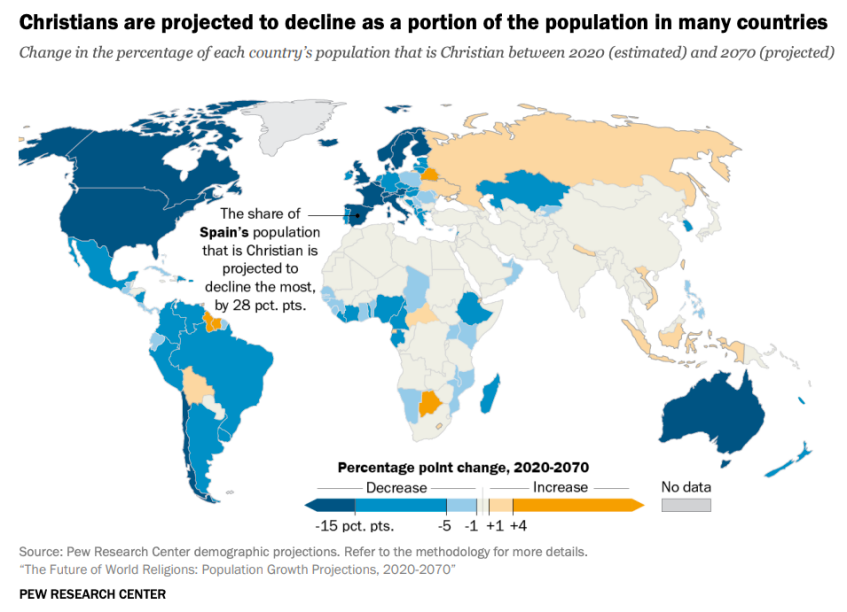
"Only four countries are expected to see Christians make up a substantially larger percentage of their national populations: Suriname, Guyana, Fiji and Botswana," the report reads.
"The countries where Christians are projected to shrink as a share of the population are scattered across every region, but most are in Europe (30 countries) or Latin America and the Caribbean (13 countries).
"The two North American countries, Canada and the US, are expected to see especially large drops in the portion of their populations that are Christian (down 20 percentage points and 16 points, respectively)."
The fast rate of growth among Muslims is attributed to higher birth rates and a younger population, with the median age of Muslims worldwide being 24 in 2020, compared with 33 among non-Muslims. Muslim births are also expected to outnumber deaths by about 1.6 billion between 2020 and 2070.
The study predicts that by 2070, Pakistan will overtake Indonesia as the country with the world’s largest Muslim population, rising from about 227 million Muslims in 2020 to 461 million.
India is expected to rank second with 334 million Muslims, although it will retain its Hindu majority.
Nigeria is projected to have the third-largest Muslim population, at 282 million.
The geographical centre of Christianity is also expected to shift, with over half of the world’s Christians projected to be living in sub-Saharan Africa by 2070. As part of this shift, the Democratic Republic of the Congo is predicted to overtake the US as the country with the largest Christian population.
Christians are projected to retain a narrow majority in Europe, with their share of the population falling from 67.1% in 2020 to 51.6% in 2070. Over the same period, the Muslim share is expected to more than double from 6% to 12.7%, while the proportion of people with no religion rises from 25.3% to 32.6%.
Pew projects that deaths will outnumber births among European Christians by about 160 million between 2020 and 2070, with a further net loss of 35 million as people change their religious affiliation. A net gain of about 14 million through migration would partly offset those losses.
"Europe’s aging and shrinking Christian population will account for most of the expected decline in Europe’s overall population," Pew said.
Among European nations, Spain is projected to see the sharpest fall in the proportion of people identifying as Christian, from 69.5% of the population in 2020 to 51.1% in 2050 and 41.2% in 2070, a drop of 28.3 percentage points over the full period. While Muslims made up 3.6% of Spain’s population in 2020, their share is projected to rise to 8.1% in 2050 and 12% in 2070.
Malta comes second, with the Christian share of the population falling from 88.6% in 2020 to 61.9% in 2070, a drop of 26.7 percentage points. The proportion of Muslims is expected to rise from 3.6% in 2020 to 10.2% in 2050 and 14.5% in 2070.
The UK is projected to see the third-largest fall in the Christian share of the population among European countries.
Pew estimates that 49.4% of people in the UK identified as Christian in 2020, while 40.2% had no religious affiliation and 6.4% identified as Muslim.
By 2050, Pew projects that nearly half (49.9%) of the UK population will have no religion and 32.7% will identify as Christian, while the share of Muslims will rise to 11.8%.
By 2070, Pew expects people with no religious affiliation to make up a majority of the UK population, at 52.3%. Christianity would remain the UK’s largest religion, but the proportion identifying as Christian would fall further to 25.4%, while the percentage of Muslims would rise to 16%.
France is projected to see a similarly sharp fall in the percentage of people identifying as Christian, from 46.5% in 2020 to 24.7% in 2070. The Muslim share is expected to more than double from 9.1% to 20%, while people with no religious affiliation are projected to make up a majority, at 53.2%.
The US is also projected to lose its Christian majority by 2070 if recent trends continue.
Pew estimates that the share of Americans identifying as Christian will fall from 64% in 2020 to 47.8% in 2070. Christians would remain the country’s largest religious group, while the percentage of Americans with no religion would rise from 29.7% to 41.3% and the Muslim share would more than triple from 1.2% to 3.7%.
The report reads, "The projected change among Christians and unaffiliated people will largely be driven by religious switching. Christians tend to lose more followers than they gain through switching in the US.
"In addition, unaffiliated Americans are younger, on average, than US Christians. All else equal, a younger group will grow faster than an older group because the younger population contains more people of reproductive age and fewer people who are nearing the end of their natural lifespans."
Elsewhere in Europe, Sweden and Germany are also projected to lose their Christian majorities by 2070. In Germany, the Christian share is projected to drop from 56.2% to 41.9%, while the Muslim share rises from 6.5% to 14.3%.
The change will be even greater in Sweden, where the Christian population is expected to fall from 60.8% to 38.8%, as the share of Muslims rises from 8.1% to 19.3%.
Austria is expected to retain a narrow Christian majority, with the percentage of Christians falling from 68.2% to 51% by 2070. Over the same period, Muslims are projected to go from 8.3% to 18.9% of the population.
In the Netherlands, Pew predicts the percentage of Christians will fall from 35.1% to 21.9% at the same time as the Muslim share rises from 5.5% to 12.8%.
In Switzerland, the proportion of Christians will fall from 61.6% to 44.8% under current trends, while the Muslim share more than doubles from 6.1% to 12.4%.
Pew attributes Muslim growth in Europe to migration as well as a younger population and higher fertility rates.
It estimates that between 2020 and 2025, the fertility rate in Europe was 1.9 children per Muslim woman, compared with 1.4 per Christian woman. Both were below the roughly 2.1 children per woman needed for a population to replace itself from one generation to the next. In the UK, Pew’s maps put the fertility rate at 2.1 to 2.99 children per Muslim woman and 1.3 to 1.69 per Christian woman.
The report found that European Christians were "notably older than those elsewhere", with a median age of 45 in 2020. The median age was 20 in sub-Saharan Africa and at least 30 in every other region where data was available.
Migration will also shape Europe’s religious make-up.
Pew projects that 18.97 million Christians will move to Europe from other regions between 2020 and 2070, while 4.95 million Christians are expected to leave the region over the same period.
If there were no further international migration, Pew calculates that Christians would make up 54.8% of Europe’s population in 2070, compared with 51.6% under its main projection.
"This is because Europe is expected to gain considerably more non-Christians than Christians through migration over the projection period," Pew said.
In Australia and Canada, people with no religious affiliation are projected to outnumber Christians by 2070.
Australia’s Christian share is expected to fall from 46.8% in 2020 to 28.8%, with the Muslim share rising from 3.5% to 9.8% and the percentage of people with no religion reaching 46.8%.
If current trends continue, Canada will lose its Christian majority, with the Christian percentage falling from 53.3% to 33.3%. The Muslim share is expected to more than triple from 4.9% to 15.6%, while the proportion of Canadians with no religion is projected to rise to 40.5%.
The report sheds light on some of the challenges for Christianity.
"Globally, Christians have one of the lowest retention rates of any religious group," it explains.
"Based on recent surveys, we estimate that 85% of people who were raised Christian still identify that way as adults. That compares with more than 90% among all other major religious groups except Buddhists, whose retention rate is 83%.
"The 15% of people who were raised Christian but no longer identify as Christian have either disaffiliated from religion altogether (13%) or switched to a different religion (2%)."
The UK is among the countries where Pew expects religious switching to make a substantial difference.
"Christian populations in certain countries have especially high rates of religious switching," the report reads.
"For example, if there were no switching, the United Kingdom would have a much higher share of Christians in 2070: 40%, rather than the 25% projected in the main scenario.
"And five of the 10 countries where Christians are expected to no longer form a majority by 2070 would retain a Christian majority under the hypothetical 'no switching' scenario: Spain, the US, Switzerland, Germany and Sweden."
The study covers 201 countries and territories and draws on census and survey data, United Nations population projections and migration estimates.