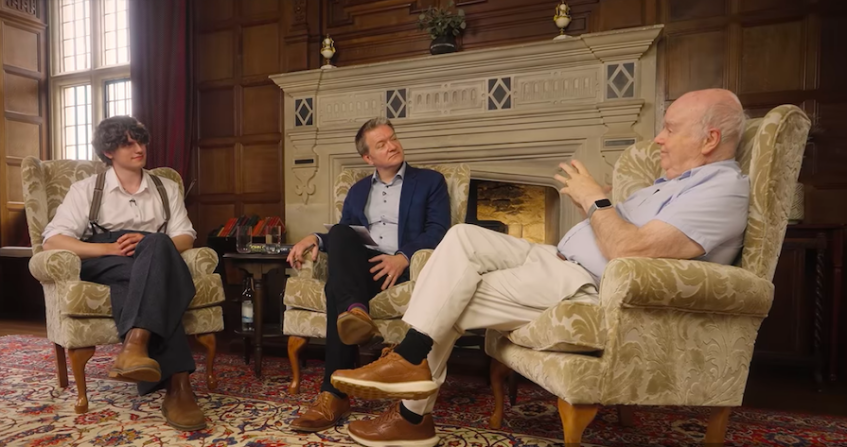
Oxford mathematician Professor John Lennox has suggested that the historical evidence for Jesus’ resurrection is enough of a reason for people to take Christianity seriously and explore its claims for themselves.
Speaking on the ‘Uncommon Ground’ podcast, hosted by Christian broadcaster Justin Brierley, Lennox discussed the resurrection, the existence of God, religious experience and the possibility of moving from scepticism towards faith with Cambridge philosophy graduate and agnostic YouTuber Joe Folley.
One of the central questions was how much historical evidence a sceptic would need to accept the claim that Jesus rose from the dead.
Folley acknowledged that the resurrection, if true, would have profound implications for how people understand and live their lives.
However, he argued that historical claims about events in the ancient world present particular difficulties because the surviving evidence is often more limited than that available for modern scientific discoveries.
While ancient historians routinely accept events on the basis of incomplete historical records, Folley suggested: “The bar for admitting a proposition that fundamentally alters the course of your life is very, very high.”
He continued: “I just think that a lot of the time atheists and Christians are talking past one another here because I think that the standards being used are different.”
Lennox agreed that historical and scientific investigations require different approaches, noting that events such as the resurrection cannot be recreated in a laboratory.
Nevertheless, he argued that the New Testament contains considerably more historical evidence than many sceptics realise and that the resurrection should be examined seriously rather than dismissed because of its supernatural implications.
For Lennox, however, historical evidence is only part of the picture. Drawing an analogy to how people choose to marry someone without knowing everything about them, Lennox argued that a person does not need answers to every intellectual question before beginning a relationship with Christ.
“The evidence is sufficient for me to take seriously the claim. But how do I go further?” he asked.
He suggested that Christianity offers something beyond historical arguments: the possibility of personally experiencing the transformation promised by Jesus.
“And I now come to human experience in the world today. Can I test this? And the answer is yes,” Lennox said.
He continued: “Because Jesus made certain claims. He said that if anybody confessed Him as the Saviour, the Son of God who had died and risen again, then certain things would happen to them.
“First of all, they would receive forgiveness of sin. They would receive peace with God. They would receive, and here's the most important thing, a new life and a new power to live as God intended them to be.
“Now, you can test that. You can test that by stepping into that world deliberately on the basis of enough evidence to make the test. You cannot know what swimming means unless you get into the water.”
Although Folley remains unconvinced by arguments for God’s existence, he acknowledged that his position has shifted from atheism towards agnosticism, largely through encounters with intelligent believers and a growing interest in religious claims.
“I try to remain open to faith and particular religious arguments but also remain unconvinced of the ones that I’ve come across,” he explained.
Lennox welcomed this openness, describing the renewed interest in Christianity among younger intellectuals as encouraging: “In the age where we’ve got the internet, we’ve got podcasts, it’s people like Joe that are opening up the discussion for many others.”
He called the YouTuber “a representative of an increasing group of younger people who are very bright and interested in these big questions without the aggressive tone”.
“And I think that can do nothing but good,” said Lennox.
Folley disclosed that he already practises prayer as a way of remaining open to the possibility of encountering God.
“We've talked before like I pray, for example, in the spirit of decreasing epistemic distance,” he said, explaining that he wants to “be epistemically and emotionally open” to the possibility of a divine being.
He added: “I pray non-denominationally. I kind of pray to a … god of the philosophers.
“I’m an unconvinced person rather than a ‘convinced against’ person. But that’s one reason why I continue to pray because I think that it's important to remain open to that.”
Although he has not experienced anything he would regard as a significant response, this has not put him off praying.
“I don't know if there's anything out there, but I am open to the possibility and I think it's important to not kind of consciously put up boundaries," he said.
Lennox responded by referring to Jesus’ teaching that those willing to do God’s will would come to recognise the truth of His teaching.
He explained: “Now, what is very interesting about that is the first premise. Not, ‘If anyone wants to know, they will know. If anyone is prepared to do, they will know.’ In other words, it's asking for an attitude that says, ‘Well, God, if you show Yourself to me, I will follow through.’
“God doesn’t reveal Himself for just ‘I'll give you the knowledge.’ There’s something about the follow through as well.”
Folley agreed that if God were to reveal Himself convincingly, he would feel compelled to reconsider his beliefs and change his life accordingly.
Another significant part of the conversation concerned what distinguishes Christianity from other religions, particularly the Christian understanding of salvation.
Folley questioned whether personal transformation could provide convincing evidence for Christianity, pointing out that followers of other religions, including Islam, Buddhism and Jainism, also describe profound changes in their lives.
He argued that while such experiences may demonstrate the personal benefits of religious belief, they do not necessarily establish which religion is true.
Lennox acknowledged that people from different religious traditions can demonstrate admirable moral qualities and experience meaningful spiritual transformation. However, he maintained that Christianity makes a distinctive claim about how people enter into a relationship with God.
Reflecting on the discussion later, Folley said he found the idea of a relationship with God based on freely given acceptance, rather than a transactional exchange, particularly interesting.
“That’s given me a lot to think about,” he said. “That was really interesting and also not something that I’d considered that much before.”
The discussion coincided with the publication of Lennox’s new autobiography, ‘My Story’, in which the 82-year-old academic reflects on his Christian faith, intellectual journey and experiences of sharing the Gospel around the world.
Explaining his motivation for writing the book, Lennox said he was inspired by Acts, particularly the account of Paul returning from a missionary journey and sharing with the church what God had done through him.
“I believe that God has done something with my life. Now, people may well be sceptical about it, but surely I can share what I believe to be the truth and put it out there,” he said.
He added: “I wrote it being very aware that the Greek word ‘skept’ means to check out from a distance. And what I hope is that this will perhaps reduce the distance for some people to come a bit further in.”
Towards the end of the conversation, Lennox expressed optimism about the growing willingness of younger people to engage with Christianity and other major questions about human existence.
“What encourages me about the whole thing [is] that here I am an ancient academic at the age of 82 and I'm meeting a young person who's just brim full of ideas and discussion and being interested in these big questions and that gives me huge hope for the future,” he said.
He praised Folley’s openness and willingness to explore questions of faith, saying: “It’s people like Joe that are opening up the discussion for many others and being honest, refreshingly honest about his own personal attitudes, the fact that he prays for example.”
Lennox also expressed his personal hope that Folley would eventually come to embrace Christianity.
“I shall pray as a Christian that something happens that really cements the truth of Christianity in his heart and mind and life,” he said.
Folley welcomed the gesture, saying: “I kind of think that regardless of where you personally stand on something, somebody's basically saying, ‘I'm going to take time out of my day to attempt to wish for you what is from my perspective the greatest thing that could ever happen to you,’ which is hard not to take well.”