Christian Astrophysicist Sees Little Chance Of Alien Life In New Earth-Size Planets Discovered By NASA

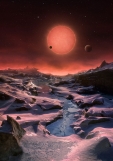
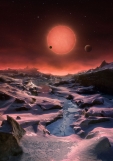
This illustration shows the possible surface of TRAPPIST-1f, one of the newly discovered planets in the TRAPPIST-1 system. (NASA/JPL-Caltech)

Seven new Earths? As in seven new habitable worlds?

That was the tantalizing possibility dangled by NASA this week following the discovery of seven Earth-sized planets orbiting a star.

All the seven planets could have the key to life –liquid water—with the chances of this highest in three of the planets located in the habitable zone, NASA said in a press release.

"This discovery could be a significant piece in the puzzle of finding habitable environments, places that are conducive to life," said Thomas Zurbuchen, associate administrator of NASA's Science Mission Directorate in Washington. "Answering the question 'are we alone' is a top science priority and finding so many planets like these for the first time in the habitable zone is a remarkable step forward toward that goal."

The seven planets were found orbiting the TRAPPIST-1 ultracool dwarf star about 40 light-years, or 235 trillion miles, away from Earth in the constellation Aquarius. These planets are scientifically known as exoplanets because they are located outside of our solar system.

One Christian astrophysicist, however, is not about to shout "Eureka!" with NASA's announcement.

Interviewed by The Christian Post on Thursday, astronomer and best-selling author Dr. Hugh Ross pointed out that the chances of these planets being habitable are small, and that they do not diminish Earth's uniqueness.

"I think that NASA is looking for funding, so I think they are actually hyping it a little more than they should," Ross said.

In an article on his ministry's website, Reasons to Believe, the astrophysicist pointed out the seven so-called Earth-size planets are orbiting an "extremely small star."

"The luminosity of the star is less than a thousandth that of the Sun," he said.

"Ultracool, fast-rotating stars exhibit frequent huge flares that are accompanied by strong x-ray and ultraviolet radiation," Ross said.

Since the exoplanets are orbiting very close to their star, this means they are tidally locked — "one side of the planet will always be facing the star, while the other side will be in perpetual darkness," he explained.

Ross said these are just some of the details that prove how special the Earth is.

"The more planets they discover, and the more we learn about them, the more we recognize how unique our own planetary system is, and its capacity to support life," he said.

related articles
Alien life possible: 3 Earth-like planets found in \'habitable zone\' around dwarf star
Alien life possible: 3 Earth-like planets found in 'habitable zone' around dwarf star

Alien life possible: 3 Earth-like planets found in 'habitable zone' around dwarf star

God\'s great work: NASA verifies 1,284 new planets, its largest collection ever
God's great work: NASA verifies 1,284 new planets, its largest collection ever

God's great work: NASA verifies 1,284 new planets, its largest collection ever

Scientists should seek God instead of aliens that could nowhere be found, says Ken Ham

Scientists should seek God instead of aliens that could nowhere be found, says Ken Ham

Ken Ham insists there are no aliens and that God created life only on Earth

Ken Ham insists there are no aliens and that God created life only on Earth

If there\'s intelligent life in another planet, would such life forms need the Gospel? Bible scholars reflect
If there's intelligent life in another planet, would such life forms need the Gospel? Bible scholars reflect

If there's intelligent life in another planet, would such life forms need the Gospel? Bible scholars reflect

New Study Showing 2 Trillion Galaxies in \'Expanded\' Universe Confirms Biblical Teaching on Astronomy
New Study Showing 2 Trillion Galaxies in 'Expanded' Universe Confirms Biblical Teaching on Astronomy

New Study Showing 2 Trillion Galaxies in 'Expanded' Universe Confirms Biblical Teaching on Astronomy

Did God Create Life on Other Planets, Or Is Earth the Only One of Its Kind? Christian Astronomer Explains Scientific Evidence

Did God Create Life on Other Planets, Or Is Earth the Only One of Its Kind? Christian Astronomer Explains Scientific Evidence

New Planets Have Been Discovered That Could Support Alien Life. Here Are 10 Questions For Christians

New Planets Have Been Discovered That Could Support Alien Life. Here Are 10 Questions For Christians

News
Being people of peace

It would be fair to say that the pace and complexity of life works against us finding any peace.

Christians and religious nones alike object to AI-generated social media videos

Evangelicals, nones and non-denominational Christians reject AI-generated videos, a new study has found.

What we don’t know about Christmas

Every Christmas people are bombarded with images of the Nativity in Christmas cards, the lyrics of songs and Nativity plays. Yet many of the images embedded in our minds are pure tradition. In fact, there is a lot that we do not know. This is the story … 

Richard Moth appointed as new Archbishop of Westminster

Bishop Richard Moth has been confirmed as the new Archbishop of Westminster, the most senior post in the Catholic Church in England and Wales.