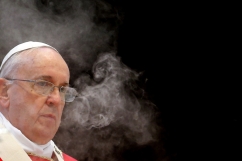
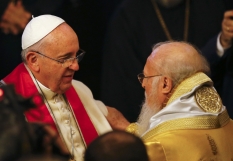
Religious leaders are heralding a new dawn in Muslim-Christian relations following the three-day visit by the Pope to Turkey.
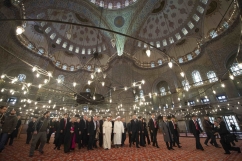
Although some Muslims in Turkey criticised his decision to pray alongside a senior Islamic cleric in Istanbul's Blue Mosque, described later by the Vatican as a "moment of silent adoration" of God, Pope Francis received nothing like the condemnation meted out to his predecessor Pope Benedict XVI when he did something similar eight years earlier.
Insiders say the difference is more than one of substance.
Pope Benedict is remembered for his controversial Regensburg address in 2006 which provoked international outrage after he quoted a medieval Byzantine emperor as saying: "Show me just what Muhammad brought that was new and there you will find things only evil and inhuman, such as his command to spread by the sword the faith he preached." The scholarly context of his remarks got lost in the controversy.
Yet overall, the records of both Popes show them as fundamentally conciliatory and respectful towards Islam, as the Catholic Church itself has been following the steps forward in interfaith dialogue set in train by the Second Vatican Council in the 1960s.
The difference is perhaps more one of style.
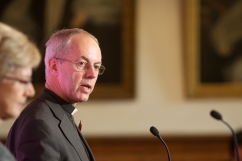
While it seems unjust that an attribute seen by many as superficial should carry such weight, the gift of being able to fashion a Christian ministry to suit today's world of quick-fire response is one with the potential to benefit not just the Church, but the entire world. It is a "chrism" shared by the Archbishop of Canterbury Justin Welby, who like Pope Francis succeeded a well-intentioned but often misunderstood scholar.
Mgr Peter Fleetwood, a priest of the Liverpool diocese based at the Holy Family parish in Southport, who also teaches at Oscott seminary in Birmingham and is a consultor for the Pontifical Council for Interreligious Dialogue, said: "Pope Emeritus Benedict is primarily a scholar and a holy man, whereas Pope Francis has shown with both Judaism and Islam that he knows about them through personal friendship."
The last Pope has many friends of other faiths, but inevitably given his background, operates at a level of deep scholarship and penetrating intelligence. Pope Francis took the initiative in the mosque when he suggested to Istanbul's Grand Mufti Rahmi Yaran that they pray together. This is a typical mark of his personal style which has such great simplicity.
On this occasion, the gesture transcended the complex divisions and disagreements between Islam and Christianity to somehow speak to the "common" human, within and without the ecclesiastical fold.
During the visit to Turkey, a mainly Muslim country, Pope Francis went on to say that equating Islam with violence was wrong. He urged Muslim leaders globally to condemn of terrorism. He also told journalists on the plane journey back to Rome why Muslims were so offended when so many in the West equated Islam with terrorism, a problem aggravated by Islamic State in the Middle East. "You just can't say that, just as you can't say that all Christians are fundamentalists. We have our share of them [fundamentalists]. All religions have these little groups," he said. "They [Muslims] say: 'No, we are not this, the Koran is a book of peace, it is a prophetic book of peace'."
He said he told the Turkish President Tayyip Erdogan it would be "beautiful" if all Islamic leaders, whether political, religious or academic, would speak out clearly and condemn terrorism as this would help Muslims.
Then this week, the Pope said he prayed that his visit to Turkey would help promote "fruitful dialogue" between Muslims and Christians.
Mgr Fleetwood told Christian Today that what Pope Francis was doing went beyond traditional interfaith dialogue: "It is all very well people like me sitting in a room with other people like me who happen to be Muslims or Jews. But unless ordinary people are helped to understand that they need to distinguish between different kinds of understandings and expressions of Islam, nothing is going to change. Pope Francis can help them to do that."
Key to this is the Pope's extraordinary populist appeal.
Mgr Fleetwood added: "I do not know exactly why but I am delighted he seems to have caught the imagination of so many people in so many countries. It is phenomenal. People talk about him everywhere, in pubs, in shops. People find out I am a Catholic priest and say to me, 'Oh isn't the Pope wonderful.' I think all Popes are wonderful but this man seems to have a real gift of convincing people he is very interested in them."
His perceptions are shared by one of the UK's most senior Muslim leaders, Shaykh Ibrahim Mogra, of Leicester, who is assistant general secretary of the Muslim Council of Britain. Unusually, this Muslim scholar and sharia consultant refers to Pope Francis using the possessive.
Speaking personally, to Christian Today, he said: "I am very excited with the way in which our new Pope is reaching out to the world, especially to Muslim communities. It is very important for these two great world religions to have better understanding and mutual respect for each other. Many of the world's current conflicts have got Muslims or Christians as perpetrators, or Muslims or Christians as victims. In light of this, it is very important for religious leaders to be calling for peace, for reconciliation, for co-existence."
He respected the previous Pope, but said he had a "different" way of doing things and might have been "ill-advised" in some of his comments.
"Pope Francis is a man who rolls his sleeves up and gets down to street level and engages with people, talks the language of the people. I certainly believe that in my lifetime, this is a Pope who will help the world heal. I cannot recall another religious leader of my lifetime who can cross so many boundaries, so many barriers, and reach people of other religions and people of no faith."
On behalf of the Muslim Council of Britain, Shaykh Mogra also welcomed the Pope's call for Muslim and other leaders to condemn terrorism and extremist violence. Shaykh Mogra said everyone should do this, not because they had been asked to by the Pope, but because it was their "religious duty". He said: "The Koran calls on us to stand up for justice and condemn injustice, even if it against ourselves and our own parents. So regardless of the region of the victims, we will always condemn evil perpetrated by fellow Muslims."
This was not somehow taking "ownership" of the terrorism, as some Muslims have suggested, but merely doing as the Koran says. It was up to leaders of other religions, he added, to decide whether they also would condemn any evils perpetrated in the name of their own faiths. "We hope the Pope's message will be heard by religious leaders and organisations of other faiths also. His message should not only be seen as a message to Muslims but to all religious leaders including Christian leaders."