Armenia's president warned on Monday that an outbreak of violence in breakaway Nagorno-Karabakh risked spiralling into all-out war, after a third day of fighting between Azerbaijan and Armenian-backed separatists.
Ex-Soviet states Azerbaijan and Armenia fought a war over the territory in the early 1990s in which thousands were killed on both sides and hundreds of thousands displaced.
The war ended with a fragile truce in 1994 marked by only sporadic violence over the years. But that ceasefire was shattered over the weekend with the fiercest fighting in years, killing dozens of people on both sides.
Despite calls from international mediators for an immediate halt to the fighting, the two sides exchanged artillery fire and reported clashes at several locations on the fringes of the mountainous enclave on Monday.
Azerbaijan's defence ministry said three of its soldiers were killed on Monday, while a representative of Nagorno-Karabakh's separatist leadership said four of its military personnel had died.
"A further escalation of military action could lead to unpredictable and irreversible consequences, right up to a full-scale war," President Serzh Sarksyan said at a meeting with foreign ambassadors in the Armenian capital, Yerevan.
A return to war would destabilise a region that is a crossroads for strategically-important oil and gas pipelines. It could also drag in the big regional powers, Russia and Turkey. Moscow has a defence alliance with Armenia, while Ankara backs Azerbaijan.
Russian Foreign Minister Sergei Lavrov said a statement by Ankara strongly supporting Azerbaijan was one-sided.
Nagorno-Karabakh is a mountainous enclave with a large ethnic Armenian population that lies inside the territory of Azerbaijan. The violence was a re-awakening of a long-festering ethnic conflict between the mainly Muslim Azeris and their Christian Armenian neighbours.
Tensions flared as the Soviet Union started to disintegrate. With help from Armenia, the region's ethnic Armenians took up arms to try to throw off rule from Azerbaijan.
By the time of the 1994 ceasefire, they had pushed Azeri forces out of almost all of Nagorno-Karabakh and taken control of surrounding districts.
Contact line
Armenian television cited the Nagorno-Karabakh military as saying 20 of its troops had been killed and 72 wounded in the three days of fighting to date.
Armenia's Defence Ministry said an Azeri drone had attacked a bus carrying Armenian volunteers to Nagorno-Karabakh, killing five people.
Each side blamed the other for starting it the weekend outbreak of violence.
Russian Foreign Minister Sergei Lavrov on Monday held phone calls with US Secretary of State John Kerry and German Foreign Minister Frank-Walter Steinmeier and stressed the need for an urgent ceasefire.
Envoys from France, Russia and the United States, joint mediators in the conflict, are to meet in Vienna on April 5 for talks on the latest fighting.
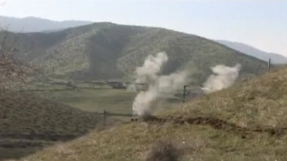
The clashes were around the "contact line," a heavily-mined no-man's-land that, since the 1994 ceasefire, has separated the Armenian-backed forces, in the foothills of the Karabakh mountains, from Azeri troops dug into defensive positions in the plains below.
Azerbaijan's military and the Armenian-backed forces attacked each other with tanks, helicopters, missile systems and artillery. Each said they had captured small chunks of territory from the other side.
On Monday, the fighting was slightly less intense than in previous days. The two sides exchanged fire but there was no sign of any concerted offensives, accounts from Azerbaijan and Nagorno-Karabakh officials indicated.
The Armenian-backed military said it had destroyed an Azeri army unit, while Azerbaijan said it had struck a separatist command point. Nagorno-Karabakh said that if Azerbaijan attacked Karabakh's largest city Stepanakert it would be met with a "very painful" response.
In Paris, Hovhannes Guevorkian, a Karabakh representative, said Azerbaijan had ceased attacking with helicopters and armed vehicles, but was now firing heavy artillery "non-stop" at towns in the southern and northern parts of the territory.
"There is an accumulation of Azeri forces all along the front line especially in the north and south of the country," he said.
Reuters was not able independently to verify these assertions.
Azerbaijan's defence ministry said it wanted to stop the fighting but that Armenian-backed forces were still "aggravating the situation", attacking Azeri positions and shelling nearby settlements, forcing Azeri troops to defend themselves.
The separatists, and their backers in the Armenian government, said Azerbaijan was the aggressor.
Underscoring the economic risks of a return to war, Azerbaijan's manat currency, which has already slumped in value because of low world oil prices, on Monday suffered its biggest fall against the dollar since December.
Azerbaijan has always vowed to restore its control over Nagorno-Karabakh but in 1994, poor and riven by political infighting, it had to accept the truce. Since then though, it has grown wealthy from exporting oil, and spent heavily on rebuilding its military.