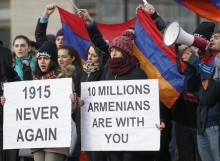
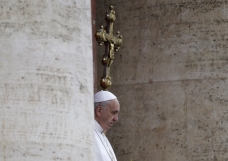
Pope Francis sparked a diplomatic row on Sunday by calling the massacre of up to 1.5 million Armenians 100 years ago "the first genocide of the 20th century," prompting Turkey to accuse him of inciting hatred.
Muslim Turkey accepts that many Christian Armenians died in clashes with Ottoman soldiers beginning in 1915, when Armenia was part of the empire ruled from Istanbul, but denies hundreds of thousands were killed and that this amounted to genocide.
At an Armenian rite Mass in St Peter's Basilica to mark the 100th anniversary of the mass killings, Francis became the first head of the Roman Catholic Church to publicly pronounce the word "genocide" to describe them.
Some European and South American countries use the term to describe the killings, but the United States and some others, keen to maintain good relations with an important ally, avoid doing so.
Turkey was swift to protest. "The pope's statements, which are far from historical and judicial facts, cannot be accepted," Foreign Minister Mevlut Cavusoglu said on his Twitter account.
"Religious offices are not places to incite hatred and revenge with baseless accusations," he said.
The Pope's statement, which is out of touch with both historical facts and legal basis, is simply unacceptable.
— Mevlüt Çavuşoğlu (@MevlutCavusoglu) April 12, 2015 " data-caption="null" data-credit="null">Religious offices are not places through which hatred and animosity are fueled by unfounded allegations.
— Mevlüt Çavuşoğlu (@MevlutCavusoglu) April 12, 2015 " data-caption="null" data-credit="null">The foreign ministry called its ambassador to the Holy See back to Ankara, and summoned the Vatican's ambassador, saying Francis' remarks had caused a "problem of trust" in diplomatic relations.
Pope John Paul II and Armenian Apostolic Church Supreme Patriarch Kerekin II called the massacre "the first genocide of the 20th century" in 2001, but that was in a joint written statement.
Francis, who has disregarded many aspects of protocol since becoming pope two years ago, uttered the phrase during a private meeting at the Vatican with an Armenian delegation in 2013, prompting a strong protest from Ankara.
As archbishop of Buenos Aires, Cardinal Jorge Bergoglio had already publicly described the killings as genocide before he was elected leader of the world's 1.2 billion Catholics in 2013.
In November, the Argentine-born pontiff made an official visit to Turkey as part of his efforts to strengthen relations with moderate Muslim states.
DENYING EVIL
At the start of the commemorative Mass, the pope described the "senseless slaughter" of 100 years ago as "the first genocide of the 20th century" and noted it was followed by Nazism and Stalinism.
"It is necessary, and indeed a duty, to honour their memory, for whenever memory fades, it means that evil allows wounds to fester. Concealing or denying evil is like allowing a wound to keep bleeding without bandaging it!" he said.
Francis's comments were also published by Armenian President Serzh Sarksyan's office on Sunday.
"We are deeply grateful to His Holiness Pope Francis for the idea of this unprecedented liturgy ... which symbolises our solidarity with the people of the Christian world," Sarksyan said in a speech at a Vatican dinner on Saturday evening.
The pope said genocide continues today against Christians "who, on account of their faith in Christ or their ethnic origin, are publicly and ruthlessly put to death - decapitated, crucified, burned alive - or forced to leave their homeland."
Islamic State insurgents have persecuted Shi'ite Muslims, Christians and others who do not share their ultra-radical brand of Sunni Islam as they carved a self-declared caliphate out of swathes of Syria and Iraq, which share borders with Turkey.
Francis also urged reconciliation between Turkey and Armenia, and between Armenia and Azerbaijan over the disputed Caucasus mountain region of Nagorno-Karabakh. The appeal came in a letter handed out during a meeting after the Mass to Sarksyan and the three most important Armenian church leaders present.