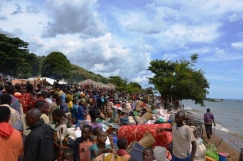
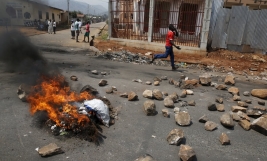
Burundi is on the brink of a "major crisis", Unicef has warned, as political strife continues to dominate the country.
Violence broke out in April last year when President Pierre Nkurunziza announced he was running for a third term, which opponents said was unconstitutional. A coup was attempted, but failed, and Nkurunziza went on to win the election in July with more than 91 per cent of the vote, amid an opposition boycott.
A fresh wave of violence then erupted in the capital, Bujumbura, in December, resulting in the deaths of more than 130 people in just two days. Donor funding dropped, and money for essential health services – to deal with cholera and malaria, for example – is now scarce. Following the failure of peace talks, European Union foreign ministers said on Monday they were prepared to strengthen economic sanctions on Burundi. The EU – the country's biggest aid donor – has promised not to stop aid, however, much of which is already being diverted to humanitarian agencies rather than the government.
According to Reuters, the UN has repeatedly warned that Burundi may be sliding into an ethnically-charged conflict, just ten years after a civil war which claimed the lives of 300,000 people. Already considered the hungriest country in the world, Burundi is facing a significant crisis.
"What we [have seen] in the health arena – which is 58 per cent reliant on external donors – is that there are cracks in the system, beginning with essential drugs," Bo Viktor Nylund, Unicef's representative in Burundi, told the Guardian.
The number of children suffering from severe acute malnutrition has doubled since December, Nylund added, and the education system is suffering.
"We're seeing similar developments both in terms of increased reports of kids not having had anything to eat when they come to school so not performing – and so teachers not wanting them in school because they're not able to concentrate – and also in terms of school materials and availability of resources for the government to actually run teacher training and so forth," he said.
He also highlighted an increase in cases of sexual and gender-based violence in Bujumbura.
"We're definitely seeing scary things on the health horizon," he said.
"Even without any more violence, there will be a major crisis, so the time to invest is now – not when it's too late... There's no way that the people of Burundi can survive with all of this support being pulled out."
Speaking to Christian Today from Bujumbura, a World Vision partner, who cannot be named for security reasons, confirmed Nylund's concerns. He is working alongside some of the most vulnerable people in the country, particularly in the southeastern and northeastern regions, where hunger is a particular issue.
"Malnutrition is indeed a subject of concern," he said. Two years ago, the Burundi government and stakeholders came together to tackle malnutrition and it fell by 10 per cent in under fives. "Now it is hard to tell exactly how many people are hungry because no recent stats are available," he said. "Figures might raise again if nothing is done."
Since December, demonstrations have continued in the capital, the source added, highlighting grenade attacks on civilians in public places. Médecins Sans Frontières treated more than 60 people including women and children earlier this week after a series of grenade explosions across Bujumbura. At least one child, a six-year-old boy, was killed. "Security remains an issue in the capital. Burundi was already a hungry country, and with the withdrawal of main donors, the situation worsened," he said.
"Burundi has an unclear future. The government seems not to be flexible in front of main donors and has no will to sit at the same table with opposition. This position led most of the donors to stop direct aid to Burundi and threaten to take much tough sanctions.
"It is difficult to predict the future of Burundi."
Also speaking from Bujumbura on condition of anonymity, a source told Christian Today that food prices in the capital have doubled since the crisis kicked in last April, and many people had been struggling to afford to eat even before then. "I don't know how people make ends meet," the source said.
Since December, "there has been a steady decline on every level – human rights, fear, distrust," they added. "People are not going out after dark; there's a huge amount of fear."
"It's hard to be hopeful," they said. Burundi is "right on the edge of total implosion, but it hasn't yet. I thought it would have by now."