History often repeats itself. And often not in the way we want it.
The Rwandan genocide in the mid-1990s led to the deaths of around 800,000 people as warring ethnic factions, the Hutus and the Tutsis, slaughtered each other mercilessly. The UN and Western intervention was conspicuous by its absence.
But now in Burundi, immediately to the south of Rwanda, it looks as if history may tragically repeat itself.
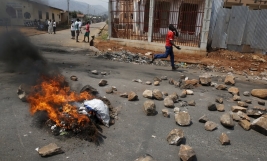
Eighty-seven people were killed in violence on Friday alone but this follows months of unrest after Hutu President Nkurunziza controversially announced he would run for an illegal third term.
The decision sparked mass protests and 200,000 people fled to neighbouring countries to escape the violence.
Fears are growing among the remaining 10m inhabitants that another civil war looms. It was only ten years ago that the country emerged from its last ethnically fuelled civil war which claimed the lives of 300,000 people. The ethnic conflict plagued the second poorest country in the world for 12 years and similar tensions are re-emerging.
Dwayne Menezes, director of the Human Security Centre, told Christian Today: "For a while now, both the government and the opposition, and forces loyal to each, have engaged in ethnically charged rhetoric, whether in the efforts of the government to intimidate the opposition through subtle and not-so-subtle threats of violence or the efforts of the opposition to intimidate the government by calling for international intervention that could change its composition."
Activists and opposition members have gone into hiding and the UN's sole response has been to impose sanctions on four people.
"We can observe today in Burundi a clear manipulation of ethnicity by both the government and opposition," the UN's special adviser on genocide, Adama Dieng, told the BBC.
"We know that ethnicity can be used to divide populations, and spreading hatred among them, which can have tragic consequences."
However little has been done and in November the UN warned it was less equipped to deal with the violence in Burundi than it was for the Rwandan genocide.
Not that the violence has gone unnoticed. On Human Rights Day Jeremy Lefroy, the Tory MP for Stafford, held an adjournment debate in the Commons on the political situation in Burundi.
"The people of Burundi have suffered enough," said Lefroy, who is a Christian. "They are not interested in power struggles between elites who think it their right to rule; they want stability and the ability to live their lives free from fear. I urge President Nkurunziza, whom I have met on two occasions, to engage fully with such mediation."
Such mediation is supported by Menezes, who told Christian Today "the time is not right for any international military intervention which would be likely to further exacerbate the conflict.
"However, it would be wise for such options to be weighed and planned should the need arise," he said.
It seems like the UN is doing just that after a draft resolution calling for an investgative team to be deployed to Burundi "as soon as possible" will be debated on Thursday.
The resolution calls for United Nations rights chief Zeid Ra'ad Al Hussein to "deploy urgently and as soon as possible a mission...to undertake a diligent and thorough investigation on violations and abuses of human rights" in Burundi.
It requests that Zeid's office "be provided with all necessary resources to fulfil this mandate," which includes permission from Burundi's government for outside experts to work in the country.
Thursday's debate is a special meeting of the human rights council called at the request of the US. It is the first such meeting since April when the council discussed terrorist attacks by Boko Haram in Nigeria.
So the lumbering edifice of the UN is moving. Slowly. But in the face of another possible genocide, western nations need to be careful to ensure history does not repeat itself.
More can be done.