
In an age dominated by technology, having church online seems like the natural progression of things. Liberty University recently threw its hat into the virtual ring with a church service held via Facebook.
Johnnie Moore, vice president for Executive Projects at Liberty, said it was the first time students on campus had the chance to join Liberty’s online students in a worship service where they could all participate.
Usually the university, located in Lynchburg, Virginia, holds a Wednesday night service in the basketball arena or in a nearby Baptist church. But last week, both venues had conflicts. So, instead of leaving the almost 5,000 people who attend the worship service hanging, school officials held a service on the social networking site.
In a recent post for CNN’s religion blog, Moore explained the reasoning behind the virtual service. He compared Facebook to church asking, “What is Facebook, after all? It’s a community. What is church, after all? It’s a community. For us, doing church on Facebook isn’t innovative. It’s intuitive. Church and Facebook are places where we share in life together, learn about one another, encourage each other, laugh together and live our lives in some kind of ramshackle harmony with one another.”
About 200 people physically gathered for the service on location, and then broadcast it via Facebook to other students on campus and locations around the world. Moore says he is convinced that if the Apostle Paul were alive today he would find a way to bring the Gospel to Facebook.
Liberty’s online broadcast is part of a growing trend cropping up across the nation. An online church is usually defined by not having a physical building where worshippers attend, though many churches, including LifeChurch.tv, offer online church in addition to services held at physical locations.
Even though it’s nice to have the option not have to leave your house on a Sunday morning, some see online churches as a serious theological issue. Dr Michael Svigel of Dallas Theological Seminary wrote in a recent blog, “virtual church is anti-church”.
He spoke on The Janet Mefferd Show Monday about online/virtual churches. During the radio show he said online churches basically reduce “the entire live worship experience to an on your desktop or on your laptop medium.”
Svigel also wrote extensively about this growing trend in a blog post. “Before any evangelical could end up careening over the cliff into legitimising an exclusively online church, his or her evangelical tradition had to have taken four wrong turns,” he said.
He highlights those “wrong turns" throughout the post, and also talks extensively about what he calls, “Fan-ification,” or turning the congregation into an audience.” This keeps churches from having a full-bodied ministry because no one is in contact with anyone else. He writes that there is no way to promote historical realities or strengthen people’s "theological convictions” in this type of setting.
Moore noted that for their Facebook broadcast, groups of students and dorms came together to watch it. It “wasn’t just a TV presentation.” He said people were still able to participate in church together, “We’re using Facebook, already a place for community, to catalyse further community."
The recent broadcast served as a test for the campus, to see what the response would be, and as they move forward they hope to start broadcasting all their services online beginning in the spring.




-

Wes Huff confesses to plagiarism, asks for prayer: 'It was sinful'
-

Wes Huff addresses plagiarism allegations
-

Jonathan Aitken says Russell Brand asked him for prayer after rape conviction
-

Where is this ‘space for faith’ that the King speaks of?
-

Attacks on Christians in Europe rise by 44%, report finds
-

‘Beyond astonishing’ that schools are encouraging children to play GTA 6, Christian group says
Most Popular
News
Does the BBC understand worship?
As a Christian minister who values both the BBC’s religion output, and the community role played by its network of local radio stations, this latest move seems wrong in so many ways.
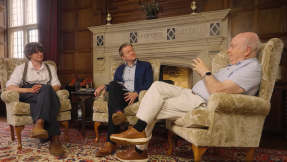
John Lennox says there is enough evidence to take Christianity seriously
Speaking with agnostic YouTuber Joe Folley, Oxford mathematician John Lennox argued that the historical evidence for Jesus’ resurrection is enough of a reason for sceptics to explore whether his promises hold true in their own lives.

Calls for inquiry as recorded assisted suicide deaths in Hawaii rise 293% since 2019
Pro-life organisation Right To Life UK has called for an independent inquiry into Hawaii’s assisted suicide system after official figures showed a record number of deaths and the state’s Department of Health acknowledged gaps in its reporting.

Can Labour tackle the youth jobs crisis without addressing its roots?
The barriers that keep young people out of work can take shape long before they leave school. Tackling them starts with supporting families and giving every child the chance to develop their gifts.





