
People in Britain are having sex less often, and more young people report that they have never had sex, according to one of the biggest studies into sexual behaviour in the world.
The fourth National Survey of Sexual Attitudes and Lifestyles (Natsal-4), published in The Lancet, draws on responses from 6,719 adults aged 16 to 59 across Britain between September 2022 and January 2024. It builds on Natsal surveys in 1990, 2000 and 2010 to track changes over several generations.
The latest survey finds that most British adults have had sex at least once in their lives (89%). Over three quarters (77%) had had sex in the previous year and the median number of lifetime sexual partners was five.
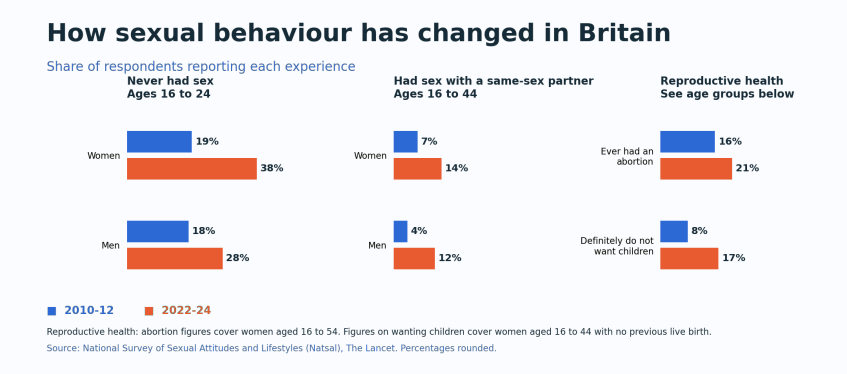
More young people say they have never had sex. Among 16 to 24 year olds, the proportion rose from 19% to 38% among women and from 18% to 28% among men between the 2010-12 and 2022-24 surveys.
The frequency of sex has decreased, with people aged 16 to 44 reporting having sex twice in the previous four weeks, down from three times in 2010–12, and four times in 1990–91.
However, the study reveals widespread use of pornography, with 81% of men and 37% of women saying they had watched it in the previous year. This rises among 16 to 24 year olds, with 86% of men and 50% of women saying they had viewed pornography in the previous year.
Soazig Clifton, academic director for Natsal at UCL and senior research scientist at the University of Glasgow’s School of Health & Wellbeing, said: “Britain’s sex lives are changing. While most adults are having sex, people are having sex less often and more young people have never had sex. There is also a higher proportion of people reporting same-sex experiences, and online sexual activity is now part of everyday life for many."
An increase in homosexual sex was also reported. Among women aged 16 to 44, the share who said they had had sex with another woman doubled from 7% to 14% between 2010–12 and 2022–24. The increase in homosexual sex among men was even greater, tripling from 4% to 12% over the same period.
Mrs Clifton cautioned however: "The increase in reporting same-sex experience has been observed in similar countries to Britain. However, the size of the increase may be somewhat overestimated in our study because people who identify as lesbian, gay or bisexual appear to have been slightly more likely to take part in this latest survey than in earlier ones."
The 2022-24 survey was the first Natsal survey to ask about sexting, which it found to be commonplace among young people, with nearly half of women aged 16 to 24 (47%) saying they had sent or received a sexual image in the previous year, compared with 44% of men in the same age group. This was considerably higher than the 22% of women and 26% of men across all age groups.
More people in Britain also reported masturbating in the latest survey, with a larger rise among women. In the latest survey, among women aged 16 to 44 who have had sex, 59% said they had masturbated in the previous four weeks, up from 41% in 2010-12 and 37% in 1999-2001. Among men of the same age who had had sex, the figure rose from 73% in 1999-2001 to 78% in 2010-12, jumping further to 84% in the latest survey.
However, young people who had never had sex were less likely to report watching pornography or masturbating than those who had. Among 16 to 24 year olds who had never had sex, 31% of women and 68% of men said they had viewed pornography in the previous year, well below the 62% of women and 93% of men who had had sex.
The survey found a similar pattern for masturbation. Among young people who had never had sex, 32% of women and 62% of men said they had masturbated in the previous four weeks, compared with 67% of women and 88% of men who had had sex.
The researchers behind the study said the findings challenge the idea that pornography and masturbation are simply taking the place of sex with a partner.
Taken as a whole, the researchers said the findings show that "the sex lives of people in Britain have shifted markedly since 1990".
Dr Wendy Macdowall, associate professor at the London School of Hygiene and Tropical Medicine, said that the findings "coincide with broader changes in young people’s lives, including rising rates of mental health conditions, declines in drinking alcohol, more time spent online and a greater proportion living at home with their parents".
She added that "more open discussion of consent may mean young people feel better able to decide whether and when to have sex".
“Without a study like Natsal, we’re left relying on assumptions, anecdotes, or extreme narratives. The data helps distinguish what’s common, what’s changing, and what actually needs attention," she said.
A companion study into reproductive health since 2010 found that a growing proportion of British women have had an abortion. In the 2022-24 survey, around one in five (21%) British women aged 16 to 54 said they had had an abortion, up from 16% in 2010-12.
Over the same period, the desire for children has decreased. Among women aged 16 to 44 who have never had children, the proportion who said they definitely did not want children more than doubled, from 8% to 17%. Among women aged 25 to 34 who have never had children, it rose from 4% to 17%.
The share of 16 to 44 year olds who were unsure about whether they wanted children also grew from 29% to 36%, while the proportion who said they definitely wanted children fell from 63% to 48%.