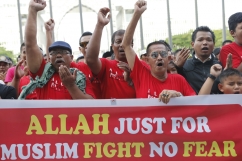
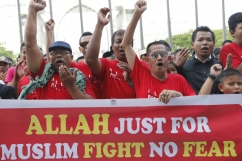
Calls by Malaysia's Islamist opposition party for strict Islamic law that includes amputations and stonings is symptomatic of a drift to more conservative Islam in politics and could further strain relations in the multi-ethnic country.
The push by the Islamist Parti Islam se-Malaysia (PAS) for the laws, known as hudud, also threatens to split a fragile opposition coalition that has been challenging the long-ruling Muslim party and its allies.
The disparate three-party opposition alliance that includes PAS won the popular vote for the first time in Malaysia's history in a 2013 election.
While the ruling United Malays National Organisation (UMNO) and its partners still won the most seats, they are more determined than ever to hold on to power which they have enjoyed since independence in 1957.
In February, the opposition alliance's leader, Anwar Ibrahim, was jailed for five years on a sodomy charge he said was cooked up to finish him politically and foil the opposition challenge.
Any lingering hope the alliance could hold together without Anwar looks doomed with the PAS bent on implementing hudud law in Kelantan state, which it controls.
Anwar's People's Justice Party and the allied ethnic-Chinese Democratic Action Party (DAP) have rejected the hudud proposal and warned that it could mean the end of their Pakatan Rakyat alliance.
"Pakatan would be pushed to a breaking point," DAP leader Lim Kit Siang told Reuters on Tuesday.
Most states in Malaysia implement sharia, the Islamic legal system, but its reach is restricted by federal law.
Hudud stipulates ancient religious punishments for Muslims who violate the law.
"Hudud is a part of the religion. As Muslims, when we are given the mandate as government, it is our responsibility to carry out these laws," said senior PAS leader Nik Amar Abdullah, who is also Kelantan's deputy chief minister.
PAS tabled amendments to introduce hudud in the Kelantan assembly on Wednesday. Media said the amendments stipulated punishments such as impalement and crucifixion for various crimes, and the execution of apostates.
Anxious to be seen just as pious as its opponents, UMNO has not opposed the push for hudud.
'EGG SHELLS'
UMNO and its allies suffered at the 2013 election because of the desertion of ethnic Chinese voters but also because many urban dwellers, including Muslim Malays, rejected the ruling bloc.
UMNO has responded by burnishing its Islamic credentials, aiming to gain ground among Malays who make up 60 percent of the 30 million population. Ethnic Chinese make up 25 percent and ethnic Indians about 7 percent.
Prime Minister Najib Razak, a self-described moderate, has been dogged by criticism from his party since the electoral setback and has tried to bolster support with concessions to conservatives, rolling back reforms and stressing UMNO's role as protector of Islam.
"The danger is some people looking at Islam as being the same to Malay-ness or Malay rights," said Ibrahim Suffian, director of Merdeka Centre, an independent pollster.
A reluctance to criticise has allowed the political influence of Islam to grow.
"We see politicians treading on egg shells with the religious authorities," said law professor Azmi Sharom.
Jamil Khir Baharom, minister in charge of state religious authorities tasked with protecting Islamic values, said the government was extending the scope of sharia over the judiciary, the Bernama state news agency reported recently.
"They have genuine fear that the position of Islam in the constitution is being threatened," said Wan Saiful Wan Jan, head of the Institute for Democracy and Economic Affairs.
"It's a reaction to society becoming more plural, more progressive, more modern."
The drive for tougher Islamic law has affected the lives of many, often in surprising ways.
In one high-profile case, three transgender women launched a legal challenge in 2011 against state Islamic laws that prohibit men from dressing or posing as women in public.
Their challenge was derided by the public.
One of the trio told Reuters in her fist interview in three years that she had changed her name and appearance several times to avoid persecution.
"They make me feel like a criminal," said the 28-year-old Muslim who now calls herself Anis.
"We don't want to go against God or Islam. We just want freedom to wear what we want and be who we are."
Other incidents highlighting the influence of sharia included state Islamic authorities interrupting the funeral of a Chinese woman, insisting on a Muslim burial because the woman had allegedly converted to Islam.
In another incident, officials stopped a Hindu wedding and took the bride away for questioning after a tip-off she was Muslim.
"If we look at the constitution, it puts Islam as the federal religion. As a result, sharia has to be upheld and in fact, it has to be strengthened," said Mohamad Shukri Mohamad, Kelantan's top Islamic scholar.