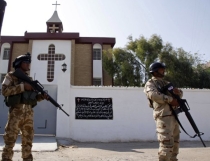
My opposite number as chief executive at the Christian satellite broadcaster SAT-7, Terence Ascott, was in Baghdad a few weeks ago, just before the latest crisis. He reported on SAT-7's Wazala website that he was very impressed during his trip "to see the positive attitude of [the Iraqi] government towards Christians and their real desire to get Christians to stop leaving the country and offering churches around-the-clock security".
This was an encouraging analysis given that Iraq's Christian population is believed to have fallen by more than a half since the end of the Iraq War in 2003. In the 1990s, Iraq's Christian community numbered at least a million, around five per cent of the total population, mostly Chaldeans (Eastern-rite Catholics owing allegiance to Rome) and Syriac/Assyrian Christians who traced their church's history back to the earliest disciples of Jesus. But the sectarian violence which engulfed Iraq after the toppling of Saddam Hussein in 2003 hit the Christian community especially hard, with bloody attacks on churches and the kidnapping or murder of Christian clerics. The worst incident occurred in October 2010, when at least 58 Christians were massacred in a jihadist attack on the Syriac Catholic Cathedral in Baghdad. As a result of this and other violent incidents, over half a million Iraqi Christians fled the country, many of them into what was at the time the relative safety of Syria.
The jihadist organisation which claimed responsibility for the 2010 cathedral atrocity was the militant Sunni group, the Islamic State in Iraq and al-Sham (ISIS), an Islamist organisation which revelled in the myth that it was too extreme in its views even for al-Qaeda, although the real basis of its dispute with al-Qaeda was, to quote one observer, not a battle about extremism but "a turf war about who would get the al-Qaeda franchise in Syria".
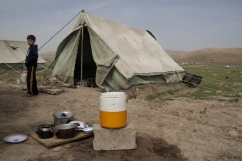
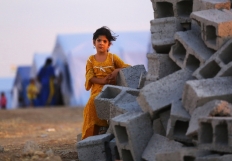
So you can imagine how Iraqi Christians felt when they saw, barely a few days after Dr Ascott's upbeat assessment earlier this month, ISIS and other Sunni militia groups opportunistically seize Iraq's second city, Mosul, one of the historic centres of Iraqi Christianity. Once again, Iraqi Christians fled from their homes, part of a desperate exodus (much of it heading northwards into Kurdistan) which some observers estimated to total around 500,000 refugees. The Emergency Director at the international NGO Human Rights Watch tweeted that this was "one of largest & fastest population movements in modern history". The number of Iraqi Christians fleeing the violence was believed to be around 20-30,000. The Christian charity Open Doors reported on one Iraqi Christian family who fled their home as soon as they heard an ISIS grenade attack on neighbouring homes: "We left the food and ran. We didn't even stop for our shoes, we fled in our sandals! We just made sure to take our ID and important papers. The children were very scared".
Within days of the ISIS takeover, the internet was awash with stories of Christian churches in and around Mosul being destroyed by the jihadists, and Iraqi Christian women being forced to wear the Islamic veil. Yet at the same time the Vatican's envoy (Apostolic Nuncio) in Baghdad was telling journalists that ISIS was not targeting Christians: "The guerrillas who are in control of Mosul have not committed any violent act or damaged the churches there. They are allowing priests to go in and out the city to administer the sacraments to the Christians who have stayed back in their homes." As with the chaotic situation in Syria, nobody really knows what is going on. Truth is always the first casualty of war.
But given the track record of Sunni Islamist extremists, we can be reasonably sure of one thing, even if this will be overlooked in the 'persecuted Christians' narrative which we hear about so much in the West. This is that ISIS will be even more brutal with members of the much more numerous Shia Muslim community in Iraq than they will with the Christian minority.
This will be because most Sunnis (even extreme ones) regard Christians as 'people of the book' (ie followers of one of the monotheistic Abrahamic religions) who are thus allowed some protection under the Qu'ran and Sharia law, even if this protection comes in the form of the restricted status of 'dhimmi' (protection from the Islamic state authorities in return for payment of a tax, known as the 'jizyah' tax). Some reports suggest that ISIS have already sought to impose such a tax on Iraqi Christians still living in the areas under their control.
Shias on the other hand, being perceived by many Sunni extremists as apostates within Islam, often receive much harsher treatment than the 'people of the book'. The horrific images which emerged this week of the massacre by ISIS of hundreds of their Iraqi opponents focused not on the military status of the victims but on their Shia faith: "apostates heading to their hole of doom" read the caption on some of the harrowing pictures.
So as with the Syrian civil war, we Christians in the West are forced to ask ourselves: will we focus only on the suffering of our co-religionists in the Middle East, or will we see that people of all faiths are suffering terribly from violence and sectarian strife? Yes, Iraqi Christians have endured a terrible situation since the fall of Saddam in 2003, but so have all Iraqis. Within 48 hours of the cathedral attack in October 2010, more than twice as many Iraqis, most of them Shias, were killed in a series of bomb attacks across Baghdad. This received much less attention in the Western media than the cathedral atrocity. If we in the West continue to show interest only in the fate of Iraqi Christians, we are ultimately doing them a disservice.
Jeremy Moodey is Chief Executive of Embrace the Middle East.