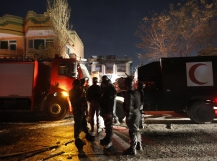
The deaths of three aid workers in Afghanistan last week showed that the country is still not safe. Taliban attacks are continuing and there are real questions about the Afghan army's ability to cope.
The Conference on Afghanistan which began in London yesterday, attended by the new Afghan president, Ashraf Ghani, Prime Minister David Cameron and US Secretary of State John Kerry, had a lot to talk about.
A major concern was what would happen when NATO's mission in Afghanistan ends on December 31, leaving only about 12,000 troops. But beyond security, there are fears that international aid, and interest, will decline as the armed forces leave, and that the developments made in the last decade will also regress.
Freshta Karimi is director of Da Qanoon Ghushtonky (DQG, meaning 'Seeker of Law' in Pashto), one of the largest legal aid organisations in Afghanistan, and was representing the views of civil society groups. Her organisation particularly focuses on the rights of women and children – women who may have been raped, forced into marriage, or be facing a difficult battle for custody of their children.
Continuing their work in areas with Taliban strongholds presents considerable difficulties. Karimi was forced to close DQG's Kandahar office after the Taliban threatened to kill her staff if they did not leave within 48 hours.
When Karimi asked why they were being targeted, the Taliban said they were supporting women who are committing moral crimes.
"They were saying it in a very nice way, saying: 'We don't want to harm you, that's why we are giving you time.'"
But though the Taliban may have sounded reasonable in their negotiations, the threat was not an empty one – a policewoman who failed to comply with a similar command, was killed as soon as the 24-hour time limit was up.
"We didn't have any choice, we could not take the risk to fight against them. Even the government cannot do anything against them. They cannot stop them coming into houses, even in the middle of the city – the places that people think are secure."
Despite the threats, Karimi knows that her experience is nothing compared with that of others, and she is driven by the prospect of a better future for Afghanistan.
"I believe in working for my people, especially women," she said. "If I do not work, who will work for my country? These people have hope that we, the educated people, will fight for them. I have to sacrifice my life for the future of my country and for the next generation. If no one is sacrificing then the country will not change."
And Karimi is confident that Afghanistan can change. Under the Taliban in the late 1990s, women were banned from work and education, and unable to leave their homes unless accompanied by a man. Following the 2001 US-led intervention, the 2004 constitution enshrined equal rights for women in law, including legal rights and access to and education. Today there are more girls in education than at any point in Afghan history, and more female Afghan MPs than in the British parliament. But there are ongoing pressures, and the record of violence against women is not a pretty one.
President Ghani, who was inaugurated in September, has given considerable public support to the changes in women's rights. Ahead of the conference, however, Oxfam warned that women could be left out of any future peace talks with the Taliban, which wouldn't exactly set a precedent for welcoming women as equal partners at the political table. And if they are not present, they cannot defend their rights.
Ghani presented a plan for peace and growth in Afghanistan over the next 10 years. One of his primary concerns is to ensure that international governments continue to give the financial aid on which Afghanistan so heavily depends.
In statesmanlike fashion, Kerry said today that he had faith in the Afghan leader to create a "strong and prosperous" Afghanistan. Similarly Cameron added his support, saying: "We will be with you every step of the way."
There is still a long way to go on that journey.
Director of the Afghan Women's Education Centre, Zulaikha Rafiq, a Christian Aid partner, said: "The situation of Afghan women is still dire. The situation for everyone could get worse before it gets better."
But ultimately, Rafiq agrees with Karimi, Afghanistan has seen great change, from which they glean hope for the future. "I think we have come a long way since the Taliban regime," she said. "I don't believe anyone is inclined to go down the same street again."
Her sentiment was echoed by President Ghani, who said in his address: "history will not be repeated, we've overcome our past".
For the sake of those he left at home, let's hope he's right.