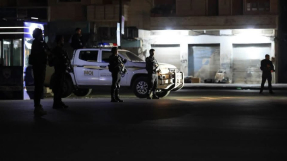
Liberia shut most of its borders yesterday and Nigeria stopped flights on its major airline Arik Air last week in an attempt to battle the worst Ebola outbreak in history.
The virus has killed at least 660 people in West Africa since February, and about 1,200 people have been infected.
The deadly outbreak that began in south-eastern Guinea in February has spread to Liberia and Sierra Leone, and the first case has now been seen in Nigeria.
Most worryingly the virus has spread to large cities with dense populations, where the infection is at risk of rampant spreading.
A prominent Liberian doctor died from the disease on Saturday, and two American Christian relief workers have also been infected.
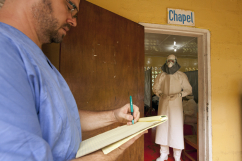
Dr Kent Brantley and Nancy Writebol were both working at an Ebola care centre run by Samaritan's Purse in Monrovia, the Liberian capital.
Dr Brantley, 33, from Texas, was the medical director at the clinic. He recognised the symptoms and immediately isolated himself.
His wife and children were living with him in Liberia but flew back to the US before he started showing symptoms. He was said to be in a stable but very serious condition.
Ms Writebol, from North Carolina, was decontaminating medical staff treating Ebola patients on an isolated ward.
She and her husband David went out to Liberia with Serving in Mission in 2013, supported by their church. Ms Writebol's condition was stable but serious.
"We are doing everything possible to help Dr Brantly and Nancy," Samaritan's Purse president Franklin Graham said. "We ask everyone to please pray urgently for them and their families."
Ebola often causes a fever, muscle aches, a headache and vomiting, and in some cases internal and external bleeding.
It is not highly contagious, as it is spread through contact with bodily fluids, but there is currently no cure or vaccine. The incubation period is 21 days, but people with the virus are only contagious once symptoms appear.
The virus has a mortality rate of up to 90%, and victims die within a few days to a week of symptoms appearing.
Between 1976 and 2008 Ebola killed 1,503. Previous outbreaks have been in rural areas, where it is easier to control the spreading.
If the virus were to spread to developed countries, which is a possibility, it is likely that it would be controlled as there are more advanced medical resources available.