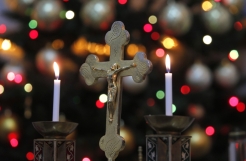
Last Christmas, a Dubai hotel welcomed its Western guests with a pink festive tinsel tree in the foyer and a bannerproclaiming: "Celebrating the REAL meaning of Christmas – the birth of Santa!"
It's an easy mistake to make, and not only for outside observers.
"He has filled the hungry with good things!" Mary exclaimed, in response to her cousin Elizabeth's rapturous welcome. And being filled with good things is certainly an expectation at Christmas.
Every year, Christian parents debate the issue of whether to feed their children the delightful innocent myth of Santa Claus or whether to be outed as killjoys for telling them that presents come from people who know and love them.
Like many children, I was fed both Christmas stories: the real one – smiling Jesus on a straw bed in a little wooden chalet shared with a cow, a donkey and no poo – and the comforting myth – the midnight advent of an obese bearded stranger in a red suit who sneaked into sleeping children's bedrooms.
Although children generally have no problem with paradox, some things in these stories didn't stack up for me. For a start, if baby Jesus was real, shouldn't we be giving him presents instead of asking for them? Then, if Santa was so generous, shouldn't he bring his own wrapping paper instead of using ours? And most importantly, if Jesus knew everything about all of us, why did he entrust the gift distribution to someone as clueless as Santa Claus, who gave all the big presents to kids who already had everything and left the poor kids with the cheap stuff?
On learning that I had been lied to by adults for years about the existence of Santa Claus, I concluded that they had lied about Jesus as well. The truth revealed at Christmas was that grown-ups concealed the truth.
The trouble with myths, both cosy-fied religion and comfy bunkum, is that they are harder to shake off than we imagine. Few adults, or children over seven, would admit to still believing in Santa – but that Christmas image of Jesus-cum-Santa-Claus may persist into adult life, even for Christians. Myths are not just for Christmas.
Santa Claus doesn't do suffering. When we experience distressing events in our personal lives, it seems theologically sound to examine whether they're caused by some hidden sin or by spiritual attack, but it may be that we still harbour a secret anxiety that we haven't been good girls and boys so Santa hasn't come to our house or has torn up our wish list.
How can that fit with Jesus who promised, "In this world you will have trouble", who arrived in this world to the tune of peace and blessing for everyone, who forgives all sins, favours the humble, empties the rich, calls the bluff of hypocrites and fills the hungry with good things?
How do we stay hungry for God, in a world that celebrates having it all? It takes grace to resist the secret fear that we've failed if we can't boast a sackful of rewards.
An unborn baby leaping for joy in his mother's womb recognised his Lord in even tinier form, and that recognition made his life whole – even life in the desert and death on a human whim. John the Baptist traded comfort for being filled, as the earth will be filled, with the presence of God.
It's that presence we hunger for. We can't afford to stave off the hunger with anything more tangible. False hope only leads to hopelessness.
So at Christmas, year upon year, we unwrap afresh the wonder and awe of the birth of a child in poverty and filth, the ruler of earth and sky, a despised refugee, the fulfiller of lives, consoler of griefs, friend of sinners and lover of nobodies.
It's not a pink tinsel life and we might not get any of the items on our wish list, nothing at all, except love that will never wear out.
Jesus can never be Santa Claus.
Thank God.
Clare Nonhebel is a novelist and non-fiction writer.