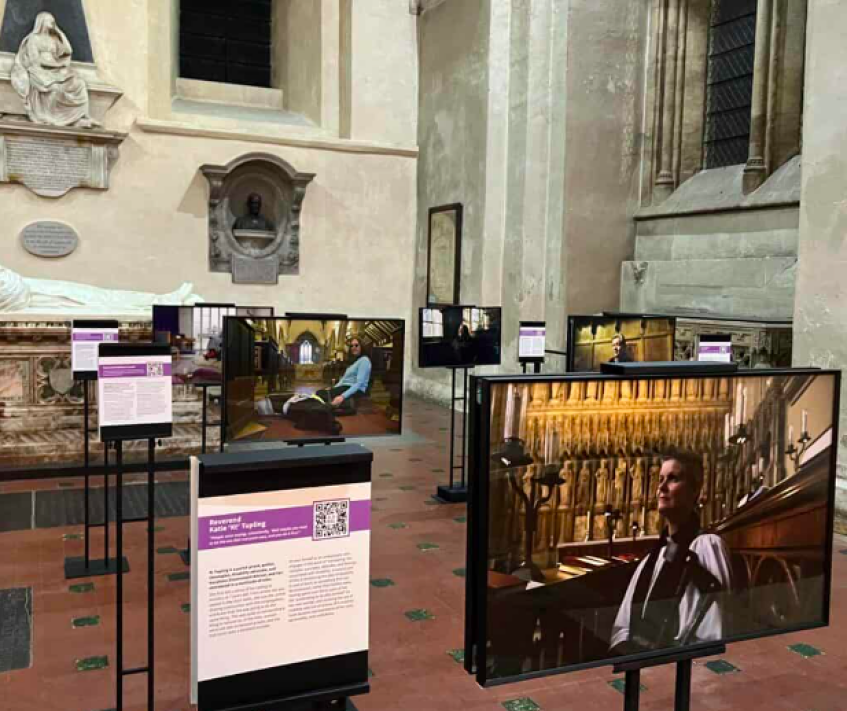
An exhibition currently touring Cathedrals and churches aims to change perceptions of leadership in the Church of England.
‘Called as we are,’ a photographic display launched at York Minster earlier this year, features 12 men and women holding offices in the CofE, who are deaf, disabled or neurodivergent.
The exhibition has toured Exeter, Liverpool and Chelmsford Cathedrals, and is just completing more than two weeks at St Albans Cathedral. It is due to be at St Giles Cripplegate, in the City of London, from January 18 to February 8, 2027.
Alongside each of the photographs are the personal stories that highlight the gifts, experiences and vocations of each of the people ministering in the Church of England.
Helen James, Disability Project Manager for the CofE’s Archbishops’ Council, explained, “There are many deaf, disabled and neurodivergent priests and ministers living and proclaiming the Gospel of Jesus Christ, but often this is unseen or unrecognised as a gift to the Church.
“Disability, neurodivergence and difference are all part of what it means to be human, to be members of the ‘human race’ who are created to reflect the image of God. The breadth and diversity of the human experience leads us to understand more of the breadth and diversity of the God we worship and whose image we reflect.”
Rev Canon Em Coley, from St Albans diocese, is one of the clergy included in the display. She said, “My hope is that people attending this exhibition will realise once again how God can use us regardless of our disabilities or limitations. Indeed, the ministry we exercise is done not ‘despite’ our limitations but is so often enhanced because of them.”
Other church leaders featured in the exhibition include Rev Vanessa Thornborough, Area Director of Ordinands and associate vicar of St John the Divine Church, New Malden, Surrey. She was born during the 1960s, when Thalidomide was found to have affected the development of babies whose mothers had been prescribed the drug for severe morning sickness. Vanessa was one of around 2,000 children impacted by Thalidomide in the UK, and was born without fingers on her left hand.
She said, “I never say, ‘I can’t do this.’ It’s always, ‘How am I going to do this?’”
Also featured is Rev Neil Robinson, chaplain to the deaf and hard of hearing community in Salisbury Diocese. He leads a deaf congregation online and also serves within the hearing church he attends in-person by leading communion. In the exhibition, Neil - who was born without hearing - recalls a powerful encounter with the Holy Spirit and release from feelings of anger, when someone prayed for him.
“He laid hands on me and prayed for me, and wow! I can only say that I felt the Holy Spirit touching me and I was flat on the floor. I felt the anger was just taken and then gone! After that, I didn’t feel angry anymore, and God was working in my life.”
In the exhibition, Neil is photographed signing from the communion liturgy, in full flow in the expression of worship. He is joyfully signing the word ‘praise.’
Also featured in the exhibition is the Ven Pete Spiers, Archdeacon of Knowsley and Sefton in Liverpool diocese. His limb development was impacted by Thalidomide during the 1960s. He believes that his presence as someone with a disability in such a role is particularly important to the Church, as it seeks to witness that everyone is made unique and precious, in the image of God.
He said, “Becoming a Christian transformed my life. I realised I wasn’t a mistake - God could use me, and he would use me.”
The exhibition, with photographs taken by Ruth Samuels, is produced by the CofE’s Disability Project, in partnership with the charity Art and Christianity.
Rev Peter Crumpler is a Church of England minister in St Albans, Herts, and a former communications director with the CofE.