Earth-like planet found circling star similar to sun at same distance as Earth's orbit

The National Aeronautics and Space Administration (NASA) announced on Thursday that it has found another planet in the Universe that closely resembles Earth.

In a news conference on Thursday, NASA's top officials announced that scientists using the agency's powerful Kepler telescope have found a planet beyond the solar system that is a close match to Earth.

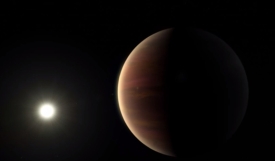
The planet is about 60 percent bigger than Earth and located about 1,400 light years away in the constellation Cygnus, the officials said.

What makes the new find more promising than the others is that the newly found planet, known as Kepler-452b, is circling a star that is very similar but older than the sun at a distance about the same as Earth's orbit, they said.

"It's great progress in finding a planet like Earth that is similar in size and temperature around a sun-like star," said Jeff Coughlin, Kepler research scientist at the SETI Institute in Mountain View, California, during a conference call with reporters at NASA headquarters in Cape Canaveral, Florida.

Based on its size, scientists estimate that Kepler-452b is rocky and Earth-like and positioned at the right distance for liquid surface water, the ingredient believed to be necessary for life.

In an earlier statement, NASA hinted of a major announcement on Thursday. "Exoplanets, especially small Earth-size worlds, belonged within the realm of science fiction just 21 years ago," the NASA statement read.

"Today, and thousands of discoveries later, astronomers are on the cusp of finding something people have dreamed about for thousands of years — another Earth," the space agency added.

Ever since May 2009, the Kepler Space Telescope has been scouring outer space for signs of habitable planets outside the Solar System.

To date, more than 4,000 planets have been found under the Kepler mission. Of this number, more than 20 have been identified to be "potentially habitable" located in the so-called "'Goldilocks Zone."

One of these planets is Kepler-186f, the first validated Earth-size planet to orbit another star in the habitable "Goldilocks Zone."

In attendance during Thursday's conference call were John Grunsfeld, an associate administrator for NASA's Science Mission Directorate in Washington; Jeff Coughlin, a Kepler research scientist at the SETI Institute in Mountain View, California; Jon Jenkins, Kepler data analysis lead at NASA's Ames Research Center in Moffett Field, California and Didier Queloz, a professor of astrophysics at the University of Cambridge, United Kingdom.


related articles
NASA: Aliens may be found by 2025

NASA's chief scientist predicted Tuesday that alien life will be discovered by 2025.

\'Hello Earth\': Comet lander Philae wakes up after months of hibernation
'Hello Earth': Comet lander Philae wakes up after months of hibernation

As if waking up from a long, deep slumber, the world's first ever comet lander has once again made contact with its team back on Earth after months of hibernation.

Alien life on comet? Data from 2 probes shows signs of ancient living organisms

Leading astronomers are now focusing their attention on images of organic-rich black crust captured by Philae on the comet 67P/Churyumov-Gerasimenko. These are believed to be indications that signs of ancient living organisms are present beneath the comet's icy surface.

Search for another Earth gets a boost as Jupiter\'s twin found circling sun-like star
Search for another Earth gets a boost as Jupiter's twin found circling sun-like star

A team of space scientists has recently found out that a planet that can be considered the twin of the gas giant, Jupiter. The newly discovered planet has a mass and occupies an orbit very similar to Jupiter.

New European Space Agency chief wants to build international village on the moon

Just a week into his job as European Space Agency (Esa), Professor Johann-Dietrich Woerner is already dreaming big. His ultimate dream right now: to be able to build an international village on the moon.

Cost of sending people back to the moon 90 percent cheaper now, says NASA study

Through a recent study conducted by the National Space Society and the Space Frontier Foundation, the NASA found out that a mission to return human beings to the moon right now will only cost $10 billion.

News
International Men’s Day: 5 prayers for the men in our lives

Today is International Men’s Day! To mark this special day, here are 5 prayers I would like to dedicate to all the men in our lives - sons, fathers, brothers, cousins, husbands, fiancés, friends, mentors, leaders, and every man who has touched our lives in one way or another.

South Sudan Christian woman killed for refusing forced marriage to Muslim

Ajak Mabior was allegedly killed by her brother and cousin.

Calls for inquiry in Austria after 22 year old with chronic fatigue died by assisted suicide

Right To Life has called upon the Austrian government to conduct an “urgent review” of its assisted suicide law.

Muslims projected to outnumber Christians worldwide by 2035

Christianity is projected to grow worldwide but lose ground across much of the West, where Muslims and people with no religion are on course to make up an increasing share of the population.