
Christians have been told they must find a framework for promoting their beliefs if they are to confront the challenge of aggressive secularisation and the erosion of Christian values across all spheres of life.
Opening the Beyond Individualism conference on Friday, Bishop Michael Nazir-Ali said it was “amazing” that a Christian nurse in Britain today could be suspended for offering to pray for a patient, when it was Christians who had set in place many of the institutions and public services now taken for granted.
He warned that the Christian values inherent in Europe’s heritage have been eroded by a process of “aggressive secularisation” that Christians must understand if they are to challenge it.
While politicians offer “thin” values like respect and tolerance, the bishop said such “political mantras” were “not enough for society to be cohesive”.
Instead, Christianity presents European nations with a means to move beyond the individualism they have come to be characterised by, he argued.
“To have individualism without any sense of mutuality is very damaging for society,” he said.
Bishop Nazir-Ali took issue with attempts to detach concepts like equality and diversity from their Christian roots, arguing that they could only be properly understood from the vantage point of Christianity, with its emphasis on the common origins of all human beings and their intrinsic value as God’s creation.
Diversity, he said, should be understood as “Christian hospitality”, rather than multi-culturalism, which has “led to the segregation and isolation of communities”, he maintained.
Bishop Nazir-Ali went on to say that respect for individual conscience “had not been in the fore” in recent legislation in Britain.
Reflecting concern over recent court cases involving Christians, he said it was “unacceptable” that the law had “ignored” the rights of Christians.
“We must respect the autonomy of public law but we also need to argue for law to respect conscience,” he told the conference.
Social critic and author Dr Os Guinness said that one of the greatest issues facing the whole world today was how to live with our differences.
He said the emergence of a global public square meant that Christians need to speak increasingly with one “constructive” voice.
Rather than contradict civil liberty, Dr Guinness said that strong religious convictions could complement it.
However, Christians must examine some of the “unwise” responses they have made in the past “to make sure we do better”.
He criticised Christians for being too politicised, partisan, and self-interested at times.
“Christians pressed our interests rather than the common good. Our rights are best guaranteed when everyone’s rights are guaranteed.
“We must be seen to be fighting for the common good.”
Just as it would be a “mistake” to rely on law alone to promote and advance Christian values, he said it would be a mistake to “count on politics to do more than it can do”.
He advocated a “civil” public square where the right for everyone to speak is tempered by a “responsibility” towards everyone else.
He warned, however, that Christians in Europe are currently too “ill-prepared” to engage and “persuade” effectively in public life.
“We need to educate a citizenry that loves Jesus but also understands the challenges of public life,” he said.
“We’re good at fighting evil but we’re not so good at thinking of constructive ways to address the challenges.”
He added: “There is an opportunity to make a breakthrough in thinking that could be a model for the entire world.”
Former Dutch defence minister Eimert van Middelkoop spoke of a prevailing “anti-Christian mood” in the European Union.
A self-confessed eurosceptic, van Middelkoop said the European project had failed to win the hearts and minds of the people, and that it had made the mistake of treating people as “economic things”.
He said there was a need to “reorganise” society across Europe according to core Christian values.
“Our continent is still in need of the Gospel,” he said.
“But it is easy to criticise. Criticising is one thing but our responsibility is to use those [Christian] values to build a better Europe.”
Continuing on from this, Christian Concern’s Andrea Minichiello Williams said there was a need for Christians to work together on a framework to safeguard Christian values at the European level.
She warned that a “tyrannical absolutism” had come to characterise public life and that Christian views were struggling to be heard in public discourse.
Mrs Williams said it was not enough for Christians to advocate values but that their Christian basis must be made clear.
“When you take Jesus out of the public discourse, nobody knows what the backdrop is,” she said.
“We need to be coherent, cohesive, have a plan, and find our voice.”




-

Wes Huff addresses plagiarism allegations
-

Wes Huff confesses to plagiarism, asks for prayer: 'It was sinful'
-

Jonathan Aitken says Russell Brand asked him for prayer after rape conviction
-

Attacks on Christians in Europe rise by 44%, report finds
-

Adult baptisms rise by a third as Church of England sees fifth consecutive year of growth
-

Where is this ‘space for faith’ that the King speaks of?
Most Popular
News
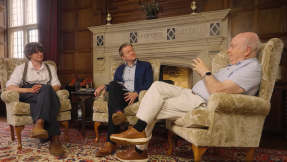
John Lennox says there is enough evidence to take Christianity seriously
Speaking with agnostic YouTuber Joe Folley, Oxford mathematician John Lennox argued that the historical evidence for Jesus’ resurrection is enough of a reason for sceptics to explore whether his promises hold true in their own lives.

Calls for inquiry as recorded assisted suicide deaths in Hawaii rise 293% since 2019
Pro-life organisation Right To Life UK has called for an independent inquiry into Hawaii’s assisted suicide system after official figures showed a record number of deaths and the state’s Department of Health acknowledged gaps in its reporting.

Can Labour tackle the youth jobs crisis without addressing its roots?
The barriers that keep young people out of work can take shape long before they leave school. Tackling them starts with supporting families and giving every child the chance to develop their gifts.

Christian group calls for prayer for forced marriage victims in Pakistan
Every year it is estimated that around 1,000 girls in Pakistan are kidnapped, forcibly converted to Islam and married, often to a much older man.





