The decision by the Turkish Republic of Northern Cyprus (TRNC) to restrict church services there to once a year has thrown into sharp relief the divisions on the island. Some Christians are claiming it's an infringement of their religious freedom. According to the TRNC, it's just a practical measure; it can't cope with the numbers.
I am not really grasping this. Why is going to church a problem?
Going to church in Northern Cyprus is a problem because most Christians live in the south of the country and there's a border to cross.
It's not a very big island, though, is it?
Size has nothing to do with it. The division between the two parts of the island is one of the most politically contentious anywhere in the world. It dates back to 1974 and shows no sign of being resolved any time soon.
So, in a nutshell...?
The island of Cyprus is occupied by both ethnic Greeks and Turks. It was given independence from the UK, which had taken it over from the Ottoman Empire, in 1960, but in the 1960s there was a movement by some of the Greeks for 'enosis' or union with Greece. This was fiercely resisted by the Turks; the two nations have never got on. The head of the Cypriot government, Archbishop Makarios, who abandoned the idea of enosis, was deposed by a Greek-run coup. Consequently Turkey invaded and took over the northern part of the island. The TRNC has not been recognised by any government except Turkey. There was horrific violence. Hundreds of thousands of people were displaced, with the Muslim Turks fleeing north and the Christian Greeks fleeing south. Turkey imported thousands of its citizens to the north.
And what happened to their houses, mosques and churches?
One of the biggest stumbling blocks to any kind of reunion is that Greek houses and land have been occupied by Turks for nearly 50 years. Many churches have been pillaged or destroyed as there is no one to look after them. Some of them are very ancient and are irreplaceable cultural treasures.
And the current dispute?
Greek Christians who fled to the south, and their descendants, want to hold services in the churches they used to worship in. It is a bittersweet experience as they are reminded again of what they've lost, but it is important to them. However, as relations have warmed considerably in recent years, they are crossing the border more often and in greater numbers, and the TRNC government says it can't cope.
That's not unreasonable, is it? There must be security issues.
The whole situation is unreasonable, but TRNC arguably has a point. However, the decision to restrict visits to once a year has been sharply criticised by the bicommunal Famagusta Initiative as "chauvinist and intolerant". Cyprus Academic Dialogue, which works for reunification, also criticised the move in a sharp tweet.
Human Rights and Freedom of Religious Worship takes a nasty blow in #Cyprus as the #Turkish #Cypriot authorities... https://t.co/RwU74ahflP
— Cyprus CAD (@CyprusCAD) May 24, 2016 " data-caption="null" data-credit="null">It seems very sad.
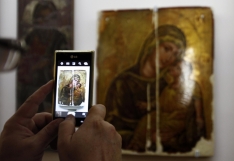
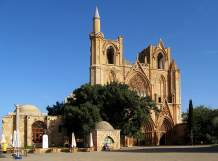
If you travel in Northern Cyprus you can visit churches that are empty and clearly in need of care. Others, such as the Apostolos Andreas monastery in the Karpaz Peninsula, have lost their local congregation and survive through tourism and a rota of volunteer priests and lay people (it's one of three monasteries unaffected by the ruling).
But the empty churches are only a symbol of deeper divisions. In recent years determined efforts have been made to work together, such as lifting visa requirements on Greek Cypriots who want to visit the North, but some observers believe permanent partition may be the only solution.