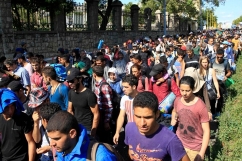
The decision by Prime Minister David Cameron to allow 20,000 Syrian refugees into Britain has been trumpeted as being in the finest tradition of our generous hospitality to the poor and needy.
That's true: Britain has always been paranoid about refugees.
The Huguenots fleeing Catholic persecution in the 17th century were accused of being a threat to jobs, housing, public order and hygiene. The Russian pogroms against the Jews in the late 19th and early 20th century sparked a wave of immigration that was met by anti-Semitic resistance. Pre-war refugees were interned as enemy aliens. The much-vaunted Kindertransport programme to rescue Jewish children from the Nazis was only permitted when relief agencies promised to fund it; every child had to have a guaranteed £50 to finance his or her eventual re-emigration, as they weren't expected to stay.
So Cameron's "generosity" – 4,000 a year for five years, and children deported when they reach 18 – is certainly British.
The question is, who exactly should be allowed in? And here a toxic brew of nationalism and xenophobia comes into play. It is seen not just in the UK, but all around the world. Hungary's Prime Minister Viktor Orban condemned the influx of Muslim migrants, saying: "Is it not worrying in itself that European Christianity is now barely able to keep Europe Christian? There is no alternative, and we have no option but to defend our borders."
In Australia, Tony Abbott's government wants to restrict any intake of Syrian refugees to Christians. Slovakia has said it will take 200 Christian migrants from camps in Turkey, Italy and Greece, as Muslim migrants wouldn't integrate as easily into Slovakia's predominantly Christian population. In France, a local mayor has said that he's willing to accept refugees in Roanne, but only if they're Christians.
Cyprus Interior Minister Socratis Hasikos said on state radio that Cyprus would accept 300 refugees, but: "We would seek for them to be Orthodox Christians. It's not an issue of being inhuman or not helping if we are called upon, but to be honest, yes, that's what we would prefer."
And in Britain, UKIP's Nigel Farage has said that it is "fine" to accept a few thousand Christians, but that's it. "[If] we have to give some Christians refugee status given that with Iraq and Libya there's almost nowhere for them to go then fine but Europe can't send the message that everyone who comes will be accepted," he told BBC Breakfast.
These are deeply troubling arguments.
Of course it's right to highlight the needs of the Christian community. But under the rhetoric about letting Christians in is another narrative: it's about keeping Muslims out. Abbott, Farage and the others who've argued for a Christian priority have linked this to wider concerns about social cohesion and national identity. Refugee policy, they say, has to take account of these.
It doesn't, and it can't, for three reasons.
1. It's true that Christians have been targeted by Islamic State. But the vast majority of its victims have not been Christians or members of other minorities. They have been other Muslims, whose theology or lifestyles didn't fit the twisted ideology of the jihadists. Prioritising one community over another makes no sense. It just reinforces the fundamentalist narrative at the core of Islamic State's beliefs, which splits the world into the pure and the impure.
2. Absolutely nothing could be calculated to stir up resentment and hostility among Muslims towards Western governments than a policy of discriminating against them because of their religion. This would not just be a perceived injustice, it would be a real one. Are we really going to say that a Christian family should be helped because they are Christians, while a Muslim family in similar or worse need will not? Discrimination like that is profoundly un-Christian. People should be accepted on the basis of need, not on the basis of creed. As Coptic Bishop Angaelos told Christian Today: "I don't think we can afford to be tribal at this moment."
3. Discriminating in favour of Christians would drive another wedge between religious communities in the Middle East and potentially make Christians even more vulnerable. Furthermore, it would encourage the extinction of Christian communities there at a time when Christian leaders are pleading for their people to stay. Melkite Greek Catholic Patriarch Gregorios III has lamented how more and more young Christians are leaving Syria due to the conflict. "The almost communal wave of youth emigration, especially in Syria, but also in Lebanon and Iraq breaks my heart, wounding me deeply and dealing me a deadly blow," Gregorios said. We shouldn't be encouraging Christians to leave, we should be making it safer for them to stay.
Does this mean that the influx of large numbers of Muslims into historically Christian Europe just isn't a problem? Of course not. It will present enormous challenges. But it is happening, and the answer is not to try to keep them out in favour of people who might be more "like us".
The question of social cohesion has to be detached from the question of asylum, or we will end up in a world of moral confusion even more puzzling than the one we inhabit already.
Follow@RevMarkWoods on Twitter.