
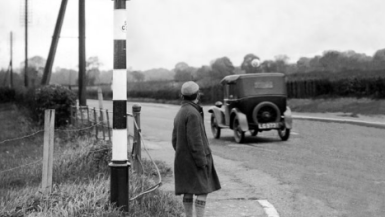
Britain in the 1930s is often remembered as a time of mass unemployment, economic hardship and the growing threat of war. However life during that decade was more complicated than these familiar images suggest.
While many people struggled, others saw living standards improve. Suburbs expanded, new industries emerged, and everyday life began to change in ways that would shape Britain for generations to come. It was also an era in which the Church and faith were still very much woven into the fabric of life.
In his new book, ‘Britain in the 1930s: A Signpost to the Future’, architectural historian and writer Steven Brindle explores a country balancing its traditions with the changes of a modern age. Using photographs originally commissioned by the Daily Mail, he brings the period to life, offering a glimpse into the homes, workplaces and communities of ordinary Britons. From the growth of suburbia to the enduring presence of churches in local life, the book reveals a society in the midst of significant change.
Christian Today spoke with Brindle about the realities of life in 1930s Britain, the role of Christianity in shaping communities and public debate, and what lessons a divided and uncertain nation from the past might still offer Britain today.
What attracted you to the 1930s as a subject for the book?
My parents grew up in the 1930s, as did many of my aunts and uncles. My grandparents lived through the Depression and the Second World War, so I have many indirect memories of the period. Many people today will similarly remember their parents and grandparents talking about life in the 1920s and 1930s.
The 1930s are often associated with the Depression and unemployment. What do we misunderstand about the decade, and what does your book reveal about life in Britain at that time?
The 1930s were more complex than the familiar picture of depression and mass unemployment suggests. While traditional industries such as coal mining, textiles and shipbuilding suffered badly, newer industries based on electricity, chemicals, photography and car manufacturing often prospered.
My own family experienced both sides, my grandfather's paper mill failed, while another family business making laundry machinery did well.
The growth of suburban Britain also tells a more positive story. Streets of semi-detached houses and bungalows offered working-class and lower-middle-class families a chance to escape inner-city slums, enjoy electricity and take holidays. The decade brought real hardship, but also greater opportunities and better living standards for many.
Your book captures a nation caught between tradition and modernity. How did ordinary people navigate these changes?
The nineteenth-century economy relied heavily on domestic service and manual labour. By the 1920s and 1930s, rising wages and expanding industries gave people new opportunities, particularly in electrical and chemical manufacturing, where many women found work.
Meanwhile, smaller and inefficient coal mines closed, leaving communities facing unemployment and painful transitions. Yet new industries, businesses, department stores and service-sector jobs offered alternatives.
The so-called "servant problem" reflected this shift: people increasingly preferred factory or shop work and independent lives to serving in someone else's household.
How important was churchgoing in 1930s Britain, and was faith beginning to decline?
Christianity remained central to everyday life. Most people identified as Christian, and regular churchgoing was still common. The Church of England was prominent, while Methodist congregations in northern England, Baptist chapels in Wales and Presbyterian churches in Scotland remained influential. These denominations helped shape regional and working-class identities. Faith was not merely a private belief but an important part of community life.
Did religious life differ between towns and rural communities?
Religious practice was broadly similar, but the settings differed. Towns were largely served by Victorian churches, built during the great urban expansion of the nineteenth century, while rural communities continued worshipping in medieval parish churches that symbolised local identity.
Parish organisations, guilds, schools and Sunday schools played important roles in both settings. As suburbs expanded during the 1920s and 1930s, new churches were built to serve their growing populations.
The photographs in your book offer a fascinating glimpse into local communities. What do they tell us about the place of churches in people’s lives beyond Sunday services?
Churches were major centres of community life. They organised social events, garden parties, fundraising and activities for children, while women often helped care for elderly people. They also supported education through parish schools and Sunday schools. Music was particularly important: Welsh congregations were renowned for their singing and male voice choirs, while parish and cathedral choirs played significant roles elsewhere.
How much influence did Christian voices have in the big national debates of the 1930s? Were churches able to shape public opinion and influence the issues facing the country?
Christianity influenced political debate, but Christians rarely agreed on the answers. Some supported pacifism and opposed rearmament through organisations such as the Peace Pledge Union. Others increasingly believed that resisting fascism was a moral and religious duty as Hitler's intentions became clearer.
Christian socialism was also influential, although Christians disagreed over whether socialism could be reconciled with Soviet communism and its atheism.
Christianity crossed political boundaries. Conservative leaders such as Stanley Baldwin and Neville Chamberlain were committed churchgoers, as were many of their opponents on the left. Faith shaped political thinking without producing a single political position.
The 1930s were a particularly difficult time for many communities affected by unemployment and poverty. How did churches respond to that hardship in places such as South Wales, Tyneside and parts of Yorkshire?
Churches helped organise relief for unemployed people and their families, supporting initiatives such as the Jarrow March and providing meals, soup kitchens and financial assistance.
Before the welfare state and the NHS, unemployment benefits were limited and means-tested, often leaving families with little support. Churches therefore played a vital role in fundraising and providing practical help to struggling communities.
Looking at the photographs, do you get a sense of a country that was still hopeful about the future, or one that was becoming increasingly anxious about what lay ahead?
They show both, although optimism dominates. Associated Newspapers took the photographs for the Daily Mail, seeking cheerful images of people enjoying seaside holidays, countryside walks, park concerts and other leisure activities. The photographers were not trying to illustrate the Depression, so the hardship experienced by many communities is less visible in the book.
Would you say that the moral and spiritual outlook of Britain in the 1930s was significantly different from that of Britain today? What has changed, and what might have remained surprisingly similar?
Britain was still a predominantly Christian society, with more conservative attitudes towards marriage, family, gender roles and authority. Capital punishment was accepted - as was corporal punishment in schools. Homosexuality was criminalised, and divorce was often difficult and stigmatised.
Many people today would consider these attitudes harsh and judgemental. People in the 1930s might, in turn, be shocked by modern divorce rates and declining religious observance.
The subtitle of your book describes the 1930s as a “signpost to the future”. What were you hoping to convey through that phrase, and in what ways do you think the decade speaks to Britain today?
The decade revealed Britain's capacity to unite in a crisis. Despite divisions caused by unemployment and disagreements over Nazism, fascism and communism, the country came together when the threat from Nazi Germany became clear.
Britain's resilience during the Second World War was one of the decade's greatest legacies. The country that prevailed was the one that had emerged from the difficulties of the 1930s. The decade therefore demonstrates Britain's ability to unite around a common purpose despite deep divisions.
Britain in the 1930s was dealing with economic pressures, social uncertainty and political division. When you look at Britain in the 2020s, what parallels stand out to you and where do you think the comparison breaks down?
In the 1930s, Britain ruled a vast empire, and patriotism, loyalty to the monarchy and pride in the nation were widely accepted. Today, these ideas are more frequently challenged, particularly in the media and higher education, where Britain's imperial history is often reassessed. Such criticism existed in the 1930s but was largely confined to a small number of left-wing intellectuals. I believe faith in the country and its national identity has weakened considerably since then, and personally, I see that as a loss.
Looking back at how people responded to the challenges of the 1930s, is there anything we can learn from this decade, where there seems to have been a stronger sense of national identity and community cohesion compared to today where society has become extremely fractured, especially young people who are struggling to have hope and sense of purpose?
The 1930s offer important lessons about belonging, generosity and community. People often had strong ties to both their local communities and the nation, helping create the society that won the Second World War and later established the welfare state to tackle longstanding social problems. More than half the population attended church, and I believe society was, in some respects, happier, less selfish and more generous in spirit.



















