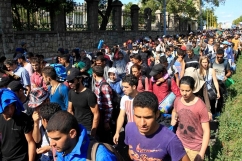
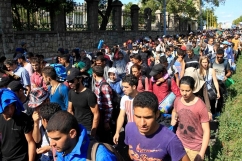
Thousands of exhausted migrants and refugees streamed into Austria on Saturday, bussed to the border by a Hungarian government that gave up trying to stop them as Europe's asylum system buckled under pressure from the sheer numbers reaching its frontiers.
After days of confrontation and chaos, Hungary's right-wing government deployed dozens of buses to take migrants from Budapest and pick up over 1,000 others – many of them refugees from the Syrian war – who had set off doggedly by foot on Friday down the main highway to Vienna.
Austria said it had agreed with Germany that it would allow them access, waiving the rules of an asylum system brought to breaking point by Europe's worst refugee crisis since the Yugoslav wars of the 1990s.
Wrapped in blankets and sleeping bags against the rain, long lines of weary people, many carrying small, sleeping children, climbed off buses on the Hungarian side of the border and walked into Austria, receiving fruit and water from aid workers. Waiting Austrians held signs that read, "Refugees welcome".
"We're happy. We'll go to Germany," said a Syrian man who gave his name as Mohammed. Another, who declined to be named, said: "Hungary should be fired from the European Union. Such bad treatment."
Bavarian state police said they expected the first refugees to arrive in Germany around midday, with national rail operator Deutsche Bahn saying a special train with 500 refugees aboard due to reach Munich around lunchtime.
Hungary, the main entry point into Europe's borderless Schengen zone for migrants surging northwards through the Balkans, has taken a hard line, vowing to seal its southern frontier within days. Hungarian officials have also painted the crisis as a defence of Europe's prosperity, identity and "Christian values" against an influx of mainly Muslim migrants.
Desperate migrants force Hungary's hand
For days, several thousand camped outside Budapest's main railway station, where trains to western Europe were cancelled as the government insisted all those entering Hungary be registered and their asylum applications processed in the country as per EU rules.
But on Friday, in separate rapid-fire developments, hundreds broke out of a teeming camp on Hungary's frontier with Serbia, escaped a stranded train, and took to the highway by foot led by a one-legged Syrian refugee and chanting "Germany, Germany!"
Citing traffic safety, Hungary said it would supply some 100 buses to take them to the Austrian border.
But the move marked an admission that the government had lost control in the face of large numbers determined to reach the wealthier nations of northern and western Europe at the end of an often perilous journey from war and poverty in the Middle East, Africa and Asia.
By Saturday morning, Austrian police said 4,000 had arrived at the border, and that numbers might more than double during the day as buses queued on the Hungarian side. Austria laid on extra trains and shuttle buses to ferry the migrants from the border town of Nickelsdorf to Vienna.
After the disturbances in Hungary, Vienna police spokesman Roman Hahslinger said: "We (have) had no problems whatsoever with the refugees, everything is very peaceful."
Men, women and children poured out of the train, saying they were resolved to continue on to Germany, and were handed food, drink and other supplies on a fenced-off platform.
"It was just such a horrible situation in Hungary," said Omar, who was travelling with his family.
"Because of today's emergency situation on the Hungarian border, Austria and Germany agree in this case to a continuation of the refugees' journey into their countries," Austrian Chancellor Werner Faymann said on his Facebook page late on Friday.
The scenes were emblematic of a crisis that has left the 28-nation European Union groping for solutions, and for unity.
Boy's body on beach pricks EU's conscience
Pressure to take effective action rose sharply this week after pictures flashed around the world of the body of a three-year-old Syrian Kurdish boy washed up on a Turkish resort beach, personalising the collective tragedy of the refugees. Aylan Kurdi had drowned along with his mother and brother while trying to cross by boat on a tiny rubber dinghy to a Greek island.
Hungary has lashed out at Germany, which expects to receive 800,000 asylum seekers this year, for declaring it would accept Syrian requests regardless of where they enter the EU, contrary to the bloc's rules.
Budapest says this has swelled the influx, and like some others in ex-Communist east European states – unused to taking in notable numbers of foreigners – it is resisting calls by some western EU leaders for each of the bloc's 28 members to accept a quota of refugees. The discord continued on Saturday.
"Obviously it's in everybody's interest not to have the same situation emerging again; that's why everybody in Europe should think twice about what they say and do," Hungarian government spokesman Zoltan Kovacs said at the border.
"If this is repeated day after day, this part of Europe will be crippled," he told Reuters.
"It is victory"
The flow of migrants and refugees risking rickety boats to cross the Mediterranean or baton-wielding police on Balkan borders shows no sign of abating despite more trips by sea ending in disaster.
On Friday about 30-40 people drowned off the coast of Libya after a dinghy carrying 120-140 Somalis, Sudanese and Nigerians deflated, causing panic on board, the International Organization for Migration said.
A record 50,000 hit Greek shores in July alone and were ferried from inundated islands to the mainland by a government already floundering in financial crisis and keen to whisk them north into Macedonia, whence they enter Serbia and then Hungary.
More than 140,000 migrants and refugees have been recorded crossing into Hungary so far this year from Serbia. On Thursday, over 5,000 crossed into Macedonia. Countless others may have entered without registering.
Determined to stem the tide, Hungary is building a 3.5-metre high fence along its border with Serbia. On Friday, the Budapest parliament adopted measures the government says will effectively seal the frontier to migrants as of September 15.
They include "transit zones" on the border, where asylum seekers would be held until their requests are processed and, if denied, they would be deported.
By nightfall on Friday, the Keleti railway terminus in Budapest, for days a makeshift migrant campsite, was almost empty as smiling families boarded a huge queue of buses that snaked out of the capital. They left shoes, clothes and mattresses scattered behind them. Helicopters circled overhead.
Alerted to rumours of buses to the border, Ahmed from Afghanistan said: "If it is true, it is victory. Maybe we can find a way now."