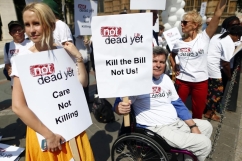
The news agenda occasionally throws up a co-incidence which shows a different angle to an old debate. Exactly that is happening this week in the UK.
On the one hand, a case is being heard by the High Court in central London, on the other, a sports tournament is happening a few miles east.
The court case involves 67-year-old Noel Conway, who is suffering from Motor Neurone disease. The terminal illness means that his condition will gradually deteriorate, losing function in his muscles and increasingly having to rely on care and machines to live his life – even helping him to breath. He is at the High Court this week seeking the right to die. He wants, when the time comes, to choose the moment of his death and to be assured that doctors and family members who assist him won't fall foul of the law.
Also this week, in the London 2012 Olympic Stadium, the World Para Athletics Championships are taking place. Tens of thousands of spectators are turning out to watch elite athletes compete in various track and field disciplines. There is a little snatch of the astonishing atmosphere that was generated around the London Olympics and Paralympics – cheerful volunteers, kids enjoying themselves and all of us united in awe at the feats we're watching as world records tumble and athletes make history.
My heart goes out to Mr. Conway who is facing an almost unimaginable prospect for most of us. He is facing an uncertain future of frightening decline in his bodily functions. No amount of modern medical intervention can completely remove the fear and even the most hardline opponents of his legal case should be incredibly sympathetic to what he and his family are being put through.
Disabled activist Jamie Hale wrote a moving piece for The Guardian this week which outlined his opposition to Mr Conway's attempt to liberalise the law. 'Disabled and terminally ill people,' he wrote, 'are being told that, while other lives can improve and other people should be deterred from killing themselves, our lives are so bad we should actually be offered assisted suicide, and it would be best for other people if we accepted it.'
Ultimately, this is what legalising assisted suicide would mean. In other countries where it has been introduced, its remit has been extended to cover non-terminal diagnoses. As Hale writes, 'in Belgium, the Netherlands, and Luxembourg (among others), assisted suicide has been legalised for people suffering from mental illness alone, and safeguards have been repeatedly ignored.'
So, what begins as a plea for a reduction in suffering for terminally ill people, quite quickly becomes an option for people outside of the 'norm'. This is the slippery slope in action. It shows the value that these societies place on people with mental health issues and other 'disabling' conditions.
Instead, turn to the stadium. When watching on Sunday evening, I was blown away by the range of different conditions the athletes had, none of which were getting in the way of them competing. The message being sent out loud and clear was that there was no limit to the potential of a person, even with a serious disability. Blind runners attached to guides by elastic ropes tore round the track at electric pace, discus throwers in wheelchairs produced amazing feats, the crowd gave huge ovations to long jumpers and javelin throwers alike.
Although I write as a Christian, this argument doesn't depend on the idea that every person is made in the image of God. Sure, that is a powerful argument for human dignity, but spend an evening at the Para Athletics championships and that much is evident – to the atheists and agnostics watching as much as the Christians, or indeed people of any faith.
The High Court shouldn't be making our laws, Parliament should be doing that. Recently, Parliament voted to keep the ban on assisted suicide, and it should remain in place.
It is incredibly difficult to see someone suffering and requesting relaxation in the law, but it should remain. To allow assisted suicide would say something too bleak and disconcerting about our society. Disabled people matter and they are of equal value to everyone else. We still have much work to do in terms of transport, accessibility, employment rights and so much more. But we need to get on with that work, rather than undermining it by legalising assisted suicide.
Follow Andy Walton on Twitter @waltonandy