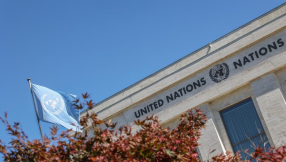
"The U.N. should spend more time doing its main job of preventing war and genocide rather than poking its nose in other countries' classrooms."
Thus said U.K. Conservative MP David Burrowes after a United Nations committee recently expressed "concern" that public schoolchildren in the U.K. are being legally required to take part in a daily act of collective worship, which is "wholly or mainly of a broadly Christian character." In its report, the U.N. Committee on the Rights of the Child said the school requirement undermines the children's human rights.
Burrowes blasted the criticism as "ludicrous." He urged the British government to "respectfully put those kinds of reports in the bin where they belong," The Telegraph reports.
Burrowes defended the children's prayer assembly, saying that the "collective act of worship is not an indoctrination exercise."
He said the daily worship recognises and respects "the Christian heritage of the country" and gives "people an opportunity to reflect."
The U.N. committee urged the British government to "repeal legal provisions for compulsory attendance at collective worship." However, the panel's recommendations are not legally binding.
As it is, parents already have the right to pull out their children from the collective worship in school. But the U.N. panel wants to go beyond that as it called on the British government to allow the children to be given the right to decide for themselves, independently from their parents, whether to attend the prayer gathering or not.
Pavan Dhaliwal, a director at the British Humanist Association, welcomed the U.N. committee's report, saying the U.K. needs to change its law for allegedly failing "its young people in far too many ways."
"Almost uniquely among economically developed countries, [U.K.] segregates [children] in schools along religious lines," Dhaliwal said.
The Convention on the Rights of a Child was adopted by the U.N. General Assembly in 1989. Article 14 specifically states that:
1. States Parties shall respect the right of the child to freedom of thought, conscience and religion.
2. States Parties shall respect the rights and duties of the parents and, when applicable, legal guardians, to provide direction to the child in the exercise of his or her right in a manner consistent with the evolving capacities of the child.
3. Freedom to manifest one's religion or beliefs may be subject only to such limitations as are prescribed by law and are necessary to protect public safety, order, health or morals, or the fundamental rights and freedoms of others.