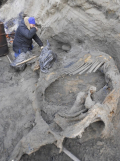
The woolly mammoth—the gigantic relative of elephants that survived in the cold environment during the last ice age—has already been considered extinct for centuries. This long-established fact, however, is not stopping scientists from trying to make these gentle giants walk on the face of the Earth again.
Several scientists are experimenting on steps to resurrect the woolly mammoth, in a process called "de-extinction" that has long been thought to be theoretically possible.
One such effort is being undertaken by the South Korean company called Sooam Biotech Research Foundation, which has earlier been reported to be experimenting on cloning dogs.
To bring the woolly mammoth back to life, the foundation is taking its cue from the relatively common process of taking genetic materials from a cell from a living or recently deceased animal and then injecting them into a donor egg, which will in turn be implanted into a surrogate mother.
For this case, Sooam is attempting to push the limits of current biotechnology by injecting the DNA from mammoth remains into an elephant egg, and then hoping that a mammoth embryo will develop for implanting into an elephant's womb.
Insung Hwang, a biomedical engineer who works for Sooam, explained that the foundation is really defying the odds with its current experiment on the woolly mammoth, fueled by a childhood fascination within his team.
"When we were children, we would go to the museum and see these large creatures that went extinct. One would be the dinosaur and the other would be ice age animals like the mammoth. That fascination carries over to when you become an adult. I had that fascination as a child," Hwang said in an article by NBC News.
The South Korean company, however, has yet to harvest a viable mammoth DNA. Mark Westhusin, an expert in genetically engineered animals who teaches at Texas A&M University, explained that this indeed will be a difficult process.
"The general procedure, taking the nucleus of one cell and transferring into another, that's easy. You can do that in different labs all over the world. But all the other things that have to come together to make an animal is difficult," he also told NBC News.