NASA's Kepler spacecraft spots 234 possible Earth-like planets in our own cosmic backyard

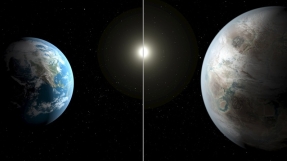
Artist's impression of habitable-zone planets with similarities to Earth: Kepler-22b, Kepler-69c, Kepler-452b, Kepler-62f and Kepler-186f. At right is Earth itself. (NASA)

The Kepler spacecraft of the National Aeronautics and Space Administration (NASA) greeted the New Year with the revelation of a trove of new possible planets in our own cosmic backyard.

During the 227th meeting of the American Astronomical Society on Tuesday, astronomers announced that the space observatory launched by NASA seven years ago to discover Earth-like planets has spotted 234 new exoplanet candidates.

These planetary candidates were discovered just tens of light years away from Earth, distributed among 208 star systems.

Andrew Vanderburg of the Harvard Center for Astrophysics said most of these new exoplanet candidates will likely be confirmed.

He also expressed optimism that the Kepler mission will spot more planetary candidates in the future. The 234 new possible planets found by the Kepler spacecraft are only the first ones from its K2 mission, started two years ago.

"We're basically finding the same kinds of planets," Vanderburg said, as quoted by Gizmodo."We've found 234 candidates in the first year of data, and there's more to come."

During its original mission, the Kepler spacecraft was able to spot more than 4,600 planetary candidates, establishing its role as a planet hunter. The telescope was able to do this from 2009 to 2013 by staring at a fixed point in the sky, scanning targets located 500 to 1,000 light years away from Earth.

The Kepler spacecraft is specifically on the lookout for faint dips of starlight, which indicate planetary transit events.

The missions also want to locate Earth-sized planets in zones that can support life around stars similar to our sun. From 2009 to 2013, the NASA spacecraft was able to spot three Earth-like planets: Kepler 438b, Kepler 442b and Kepler 452b, fuelling enthusiasm about the possibility of alien life in space.

Vanderburg further explained that the new findings from the Kepler spacecraft can help in determining the statistical distribution of all planets in our galaxy.


related articles
Are we alone in the universe? Scientists  find no sign of alien life in 93 galaxies
Are we alone in the universe? Scientists find no sign of alien life in 93 galaxies

Are we alone in the universe? Scientists find no sign of alien life in 93 galaxies

Water on Mars: What it says about God\'s great universe
Water on Mars: What it says about God's great universe

Water on Mars: What it says about God's great universe

Pope Francis on alien life possibility: Let\'s \'stick\' to what scientists say but at the same time keep faith in God
Pope Francis on alien life possibility: Let's 'stick' to what scientists say but at the same time keep faith in God

Pope Francis on alien life possibility: Let's 'stick' to what scientists say but at the same time keep faith in God

Alpha Centauri Bb, closest planet similar to  Earth, is just a \'ghost,\' scientists admit
Alpha Centauri Bb, closest planet similar to Earth, is just a 'ghost,' scientists admit

Alpha Centauri Bb, closest planet similar to Earth, is just a 'ghost,' scientists admit

Extraterrestrial life more likely to be found in planets close to each other, says study

Extraterrestrial life more likely to be found in planets close to each other, says study

News
English Heritage deletes debunked claims about pagan origins of Christmas Day

English Heritage has admitted it got it wrong when it shared false claims that the date of Christmas is derived from a pagan Roman festival in honour of a sun god.

Guinness Book of Records recognises 'the world’s longest serving Sunday School teacher'

Pam Knowles started helping out her church Sunday school in 1951 at the age of 13.

The origins of ‘traditional’ Christmas celebrations 

Today in the UK we celebrate Christmas and the period around it with many familiar traditions and activities. There is an understandable assumption that we have always done things this way. However, celebrating Christmas has a long and complex history and things change over time. 

Venezuela stops cardinal from leaving country

The cardinal has spoken out against the excesses of the Maduro government.