Extraterrestrial life more likely to be found in planets close to each other, says study

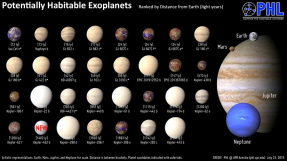
Over the last five years, the hunt for other planets outside the solar system has yielded overwhelming results with the discovery of thousands of Earth-sized worlds, all holding the possibility of harbouring life.

Because of these new, exciting discoveries, astronomers and space enthusiasts may find it hard to figure out where exactly to point their telescopes in search of extraterrestrial life.

A new study may have provided answers on where to begin looking for alien life.

A paper written by astrophysicists Jason Steffen of the University of Nevada and Gongjie Li of Harvard's Center for Astrophysics stated that there is a higher likelihood to find alien life in planets very close together.

According to a report published on Gizmodo.com, Steffen and Li used numerical models to demonstrate in their study that two worlds could help each other sustain life if a celestial pairing occurred in the right place.

How could this be possible? The explanation is pretty simple: When two planets are close to each other, microorganisms could easily hitchhike between the two worlds and increase their chances of survival in case of a planet-sterilising event.

This process is scientifically known as "lithopanspermia," wherein microbial life travels between planets via comets, asteroids, and ejected particles. Some scientists even subscribe to the idea that life of Earth began with this very process.

Another fascinating view put forward by the research is the likelihood that alien bacteria can survive a life-ending event in their host planet, and even be spewed and whizzed off into space, ending up in a nearby world.

"The burden of surviving catastrophic events is shared between multiple planets in the same system," Steffen explained at a press conference on his study, as quoted by Gizmodo.

"Multi-habitable systems could have a microbial family tree with roots and branches simultaneously on two different planets," he added.

Steffen and his colleagues now plan to study data from NASA's forthcoming Transit Exoplanet Survey Satellite (TESS) mission, which will scour stars near Earth-like planets.

"Systems like those that we investigated, and moon systems orbiting a habitable-zone giant planet, are among the few scenarios where life—intelligent life in particular—could exist in two places at the same time and in the same system," he explained.


related articles
Are we alone in the universe? Scientists  find no sign of alien life in 93 galaxies
Are we alone in the universe? Scientists find no sign of alien life in 93 galaxies

Are we alone in the universe? Scientists find no sign of alien life in 93 galaxies

Oddly flickering star 5.8 trillion miles from Earth fuels speculation of alien civilisation

Oddly flickering star 5.8 trillion miles from Earth fuels speculation of alien civilisation

Pope Francis on alien life possibility: Let\'s \'stick\' to what scientists say but at the same time keep faith in God
Pope Francis on alien life possibility: Let's 'stick' to what scientists say but at the same time keep faith in God

Pope Francis on alien life possibility: Let's 'stick' to what scientists say but at the same time keep faith in God

Astronomers begin hunt for alien life on  mysterious flickering star
Astronomers begin hunt for alien life on mysterious flickering star

Astronomers begin hunt for alien life on mysterious flickering star

Alpha Centauri Bb, closest planet similar to  Earth, is just a \'ghost,\' scientists admit
Alpha Centauri Bb, closest planet similar to Earth, is just a 'ghost,' scientists admit

Alpha Centauri Bb, closest planet similar to Earth, is just a 'ghost,' scientists admit

News
Richard Moth appointed as new Archbishop of Westminster

Bishop Richard Moth has been confirmed as the new Archbishop of Westminster, the most senior post in the Catholic Church in England and Wales. 

The mystery of the Wise Men

The carol assures us that “We three kings of Orient are…” and tells us they were “following yonder star”. Can we be sure there were three of them? Were they kings? Where in the Orient were they from? What was the star they followed? In fact, there is a lot that we just do not know. This is the story …

English Heritage deletes debunked claims about pagan origins of Christmas Day

English Heritage has admitted it got it wrong when it shared false claims that the date of Christmas is derived from a pagan Roman festival in honour of a sun god.

Guinness Book of Records recognises 'the world’s longest serving Sunday School teacher'

Pam Knowles started helping out her church Sunday school in 1951 at the age of 13.