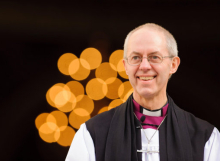
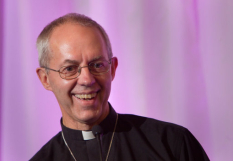
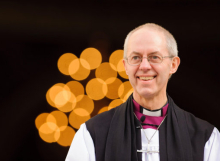
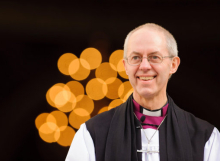
"The proportion of Muslims who are radicalised is extraordinarily small...I think we've been becoming too hysterical about this subject for some considerable period," warned Archbishop Justin Welby in a candid interview.
Speaking to Andrew Marr, the Archbishop addressed a wide range of topics with his usual honesty, perhaps most notably highlighting his understanding of the growing influence of Islam across Britain – particularly in light of the conflict in Syria and the Trojan horse scandal in schools across Birmingham.
"Clearly there's an issue with people going to Syria and coming back highly radicalised – there is a problem with radicalisation. But the proportion of Muslims who are radicalised is extraordinarily small, and I'm just edgy about developing a national culture of fear, because I don't think that gets us anywhere," Welby explained.
"I think we're in danger of slipping into a very fearful culture in which we see everyone against us and us against everyone and we're constantly trying to defend ourselves. This country is much bigger than that, and much better than that."
He insisted: "I think we've been becoming too hysterical about this subject for some considerable period, and it is a worry because we have huge differences with Islam as Christians, but that is absolutely no reason for hostility, quite the reverse".
In fact, with regard to the tensions between Islam and Christianity, the Archbishop suggested it was a "very complex area" but that inter-faith dialogue remains vital, as does extending grace to those who believe differently.
"The ancient principle of the church starts in hospitality, in welcome, in arms opened wide to all and everyone, and to listening, to being ready to explain our faith but to do so with grace," he asserted.
"If other people want to behave differently, that's fine, our duty is that grace and hospitality and welcome and love that is universal and unconditional."
Additionally, Marr asked Welby about his personal stance on same-sex marriage – noting that he has remained fairly conservative on that particular issue, while holding more a more liberal understanding on women bishops. Marr labelled this a "big contradiction" while Welby, however, insisted that it is possible to reconcile the two.
"The theological difference is quite a simple one, which is, I think, that theologically the Church has been wrong not to ordain women as priests and bishops over the centuries. And I think if you look back at scripture, if you look at the nature of God, if you look at particularly the way the early Church organised itself, we got caught up in the culture over the centuries as churches do at all times," he said.
"The issue over sexuality I'm very loathe to comment on in detail," Welby continued. "Yes, I was very clearly against same-sex marriage when the bill came through, and the position of the Church remains unchanged on that...But we're beginning a process of guided conversations, shared conversations, in the Church, and I just want to let those take their course and not pre-empt the way we are going to emerge from those decisions.
"To be absolutely clear, I have not been convinced by the arguments for same-sex marriage as 'marriage'."
Welby admitted, however, that he continues to "struggle with the issue".
"Pastorally, you meet people, you sit across the room from them, you talk to them – there are some wonderful priests – and your heart goes out to them," he noted, going on to agree with former Archbishop Rowan Williams' recent assertion that the Church's stance on homosexuality is "unstable".
"We're in the middle of a prolonged period of disagreement and conversation and therefore by definition it is unstable, and that's something we have to deal with," Welby added.
"But our calling is to love one another and to find ways of good disagreement in a world that is completely incapable of good disagreement."
Other subjects discussed by the Archbishop were tax avoidance – "I think people have a duty to make a proper contribution to society in a way proportionate to their income" – and his recent admittance that there will likely be further discovery about sex abuse scandals within the Church.
"It is becoming clearer and clearer that for many, many years things were not dealt with as they should have been, and we must show justice to survivors of abuse – that is the first and absolute principle," he declared.
"We must be absolutely transparent in every possible way and we have to keep saying how utterly devastated we are with the terrible things that were done in the past and how sorry we are."
With a characteristic jovialness, Welby ended his interview by sharing of his personal journey to faith since "a very crucial moment of commitment to following Christ" when he was 19.
"It goes on and on and it changes the whole time, it's never the same," he said, before laughing of his time as Archbishop: "I'm rather worried about the fact that on most things, most of the time, I'm really enjoying myself".