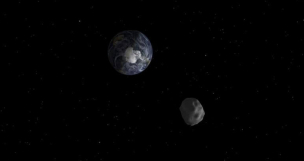
Primarily because of Hollywood films, the whole world has become aware of the big threats posed by asteroids to Earth. In the movies, teams of astronauts and space researchers almost always find a way to prevent these large, unstoppable blocks of rock from colliding with our planet, and wiping out the human race.
These things, however, are works of fiction. The National Aeronautics and Space Administration (NASA) is nevertheless looking for real-life ways to save the world from asteroids, and the first idea to do this: creating a spacecraft to ram straight into an approaching asteroid.
This plan, called the Asteroid Impact and Deflection Assessment (AIDA), will involve two phases. In the first stage, the European Space Agency will collect data on the approaching asteroid by putting a satellite into orbit around it.
In the second phase, NASA will send the spacecraft to a head-on collision with the asteroid, not necessarily to blow it into pieces, but to at least bump it away from Earth.
"To deflect an asteroid that may be on an impact path with the Earth, we simply must either speed up its orbital velocity a small amount or slow it down a small amount," Lindley Johnson, an executive of the NASA's Near-Earth Objects Program, explained in an article on The Daily Beast.
The challenge now, according to Johnson, is to find out how much force is necessary for effective asteroid defence. Asteroids usually go around the Sun with velocities relative to Earth that average about 12 miles per second.
"But if you were to add or subtract just an inch per second of velocity to the asteroid, that will over time change the position of the asteroid in its orbit enough that in a couple of years the asteroid will miss the Earth rather than hit," Johnson said.
Solving the asteroid defence equation, however, does not end there. Johnson said the space agency still has "to determine how much force is required to impart that inch per second of velocity change," which depends on the mass of the asteroid.
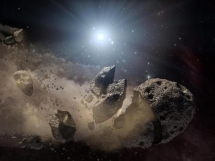
"One of the concerns that must be better understood is the coherent strength of the hazardous asteroid.
Is it strong enough to absorb the force of the kinetic impactor, or will it simply break up into smaller pieces still headed on pretty much the same impacting trajectory?" Johnson wondered.