In Dubai's overflowing churches and Riyadh's secretive masses, Catholics across the Gulf are eagerly awaiting Pope Francis' historic visit to the United Arab Emirates next week.
They hope the first ever trip by a pope to the Arabian Peninsula will foster greater acceptance for its two million expatriate Catholics, many from India and the Philippines.
They want better transport to UAE churches and permission to build them at all in ultra-conservative Saudi Arabia.
The trip comes as the UAE makes a push to show it is a country tolerant of other religions and at a time of social reform elsewhere in the Gulf.
The visit would reflect 'what the UAE has always been: a cradle of diversity, centred between East and West, connecting people, religions, goods, and cultures', said a UAE government spokesman, Jaber Al Lamki.
The Vatican says the trip will focus on inter-religious dialogue and peace.
'It will help the Gulf and the whole world understand there should be respect for each religion,' said Claudia Rumie, a maths tutor from Colombia.
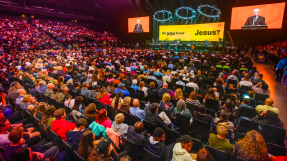
She attends mass near Dubai's Jebel Ali port in a church on a compound with houses of worship from other faiths and will be among the 120,000 Catholics attending the pope's mass in a sports stadium in Abu Dhabi.
Most UAE citizens are Sunni Muslims, but foreigners, often working in offices, schools, homes and constructions sites, outnumber locals by around nine to one. Around half the Gulf's Catholics live in the UAE.
Priests, worshippers and two diplomats said that while the UAE is already the most tolerant Gulf country towards faiths other than Islam, there are restrictions.
The authorities forbid unsanctioned religious gatherings and non-Muslims must not proselytise, according to the law. Churches do not ring bells and do not display visible cross, according to church building agreements, church officials say.
Land for building houses of worship is limited so there are only nine Catholic churches in the UAE. Pews are packed at the weekend, with parishioners spilling outside where mass is sometimes broadcast on screens.
Father Reinhold Sahner, the German parish priest of St Francis church in Dubai said some parishioners have long bus journeys to church.
'It is good that the pope comes and knows about our realities, he knows also about our difficulties,' Sahner said.
Although the pope will only go to the UAE, his visit is being watched closely by Catholics elsewhere in the peninsula, who are also hoping for more acceptance.
In Qatar churches are allowed but Catholics say they feel restricted outside their place of worship.
Qatar's first Catholic church, the 3,000-seat Church of our Lady of the Rosary, was built in 2008 in a walled-off compound known as the Religious Complex, on the southern outskirts of the capital. It has a permanent security checkpoint.
'We are free and can celebrate mass, but the condition is that you can only do these things inside the complex,' said parish priest Rally Gonzaga.
The Qatari foreign ministry did not immediately respond to a request for comment.
Churches are also allowed in Oman, Kuwait and Bahrain but in ultra-conservative Saudi Arabia, they are banned.
Some Catholics in Riyadh attend mass in private homes and embassies, where they say their presence is monitored but largely ignored by authorities.
The Saudi government communications office did not immediately respond to a request for comments.
One worshipper said he gave the compound gatekeeper a password to attend a regular embassy service.
"It's kind of secure and protected but I don't talk about it with my colleagues," he said.
Recent outreach by Saudi Arabia to Christian representatives has given Christians hope for change.
Last year King Salman met the head of the Vatican's pontifical council for inter-religious dialogue in Riyadh. Lebanon's Christian Maronite Patriarch also visited to discuss religious tolerance and combating extremism, according to Saudi state media.
Crown Prince Mohammed bin Salman has promised to promote interfaith dialogue as part of his domestic reforms.
He said he wants "middle-of-the-road, moderate Islam open to the world and all religions, traditions and people". He met the head of the Anglican church in London last year and also visited Egypt's largest Coptic cathedral.
Catholic Toni El-Rahi, who moved to Saudi Arabia from Lebanon in 1994, says attitudes among regular Saudis are shifting with the reforms.
"They also have to go with the flow," he said.
Catholics don't feel comfortable wearing crosses, he says. But his family allowed media to photograph Christian iconography at their home and he no longer fears the religious police whose wings have been clipped to loosen strict morality rules.