
|PIC1|Integral mission is "foundational" to the church's response to some of the biggest challenges facing the world today, believes the head of the World Evangelical Alliance, Dr Geoff Tunnicliffe.
Addressing the Christian Management Australia conference at Bondi Beach last week, Dr Tunnicliffe said that a clash of world views, increasing secularism and post-modernism were just some of the "major" challenges to global stability.
He acknowledged that evangelicalism had for many people around the world become synonymous with a narrow social agenda and in some cases US foreign policy, whilst faith communities in some western countries were being "pushed to the edge" of society by the torchbearers of radical secularism.
Other challenges, he noted, were the impact of climate change and current food crisis, changes in immigration trends, the HIV and Aids pandemic across large parts of Africa and India, and the growing number of children at risk, particularly from human trafficking for labour or sexual purposes.
He explained: "It is not simply that evangelism and social involvement are to be done alongside each other, but rather it's that through integral mission our proclamation of the Gospel has social consequences as we call people to repent in all areas of life. Our social involvement has evangelistic consequences in that we bear witness to the transforming grace of Jesus Christ."
Dr Tunnicliffe said that leaders modelled on Christian world changers like William Wilberforce, who spearheaded the abolition of the slave trade, were the key to fulfilling such a vision of integral and transformational mission.
"Here is the model of a Christian and a powerful demonstration of how a Christian engaged in culture," he said. "I think we can actually use some of the principles of William Wilberforce to guide societies around the world."
Breaking down those principles, he said that transforming societies had to begin with a broken heart.
"Wilberforce's heart was broken by the slave trade. What breaks our heart today?" he asked. "I think as we look at the needs of the world, that's where we have to start."
Dr Tunnicliffe encouraged Christians not to become discouraged by the enormity of some of the challenges, but instead be inspired by Wilberforce's stand against the social norms of his day.
|QUOTE|"The reality is that as Christians in society, sometimes we feel that we are a small minority," he said. "But I believe that there are resources within our community that can transform the world.
"It's not about numbers, but about passion," he added.
Dr Tunnicliffe urged Christian leaders to dream big and engage with the whole of society and culture.
He pointed to the Micah Challenge movement which is a partnership between Micah Network, an association of 300 Christian organisations worldwide, and WEA are holding governments accountable for the promises they made to halve global poverty by 2015.
"Sometimes governments have a way of signing something and not following
through," he said. "Sometimes when I meet parliamentarians or prime ministers I say, 'You signed this, now we want to hold you accountable.'"
Dr Tunnicliffe told world governments to "pay up" according to what they had promised.
"You say that you're going to put x-amount into debt reduction or aid? Pay up. You say you will change your government from being corrupt? You need to do that. These requests are at the heart of the gospel. What we're saying is: we need action."
He added that it is not just up to governments to respond to the poor but Christians also needed to deepen their commitment to the poor, speak up for the voiceless, and keep going in the face of adversity
"We do face challenges. We face opposition in many ways. But ... if God has raised you up, if God is with you, then God will give you the resources that you need," he said. "No one will be able to be against you."
Dr Tunnicliffe also exhorted the leaders to "serve with Christ-like humility".
"You can't serve someone unless you understand them," he said. "You can't understand others until you learn from them. You can't learn about someone until you're in a trusting relationship with them. To build trust, they need to know that you accept and value them as people."
Dr Tunnicliffe reminded Christians to be leaders of hope and lead by having "power with people, not power over people".
He concluded: "It is out of our biblical understanding we engage. That's the kind of leaders that I think will impact this world today."



-

UN officials demand explanation for Iranian church seizure
-

AI could become a ‘very dangerous master’, warns John Lennox
-
Archbishop of Canterbury withdraws award given to Muslim cleric who praised Bin Laden
-

Calls for Church of England to be 'rooted in scripture' ahead of General Synod elections
-

Most practising Christians are evangelical, study finds
-

Church of England blessing same-sex relationships 'a bridge too far'
Most Popular
News

People view religious education positively, study finds
The government is consulting on plans to add RE to the national curriculum.
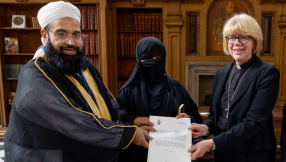
Archbishop of Canterbury withdraws award given to Muslim cleric who praised Bin Laden
Reform leader Nigel Farage said the decision to award Hafiz Muhammad Tahir Mehmood Ashrafi was "astonishing".
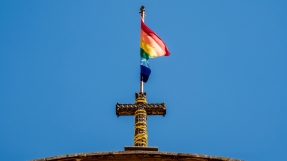
How the new General Synod could move beyond the present disagreement over same-sex relationships
How might the next Synod make progress in the next five years based on a recognition that there are those in the Church of England who hold fundamentally opposed positions on the matter? Is there a way of allowing both sides to achieve what they want? Martin Davie argues that the answer to this question is ‘Yes.’
No part of London should become a free speech, gospel exclusion zone
Soho is not exempt from freedom of speech and Christian expression. And Christians do not lose their fundamental freedoms when they cross an invisible boundary into a neighbourhood associated with a different worldview. The streets of London belong to all of us, writes Andrea Williams.








