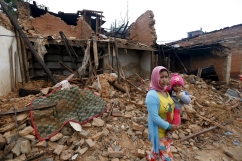
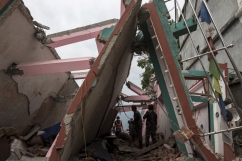
Earthquake-battered Nepal will ask international donors to support a reconstruction plans that is expected to cost $6.6 billion over five years, the government said on Saturday.
Two quakes on April 25 and May 12 killed 8,787 people and destroyed more than 500,000 homes, affecting 2.8 million of the Himalayan nation's 28 million people.
Losses to the economy from Nepal's worst disaster on record stand at $7 billion, including from tourism, the government said in a Post Disaster Needs Assessment (PDNA) report.
Suman Prasad Sharma, a senior finance ministry official, said 36 countries and 24 donor agencies had been invited to a conference on June 25 to pledge support for reconstruction.
"We have expectations of a very handsome and good support from our donors during the conference," Sharma said at a function in Kathmandu. Currently, Nepal gets two-thirds of the cost of its economic development in international aid.
Government officials said some donors who cannot pledge more aid could still help Nepal by writing off debt the country owes or delaying repayment schedules. Nepal does not have commercial borrowings from international lending agencies.
Concessional loans mainly from the World Bank and the Asian Development Bank account for 18 percent ofNepal's gross domestic product, according to the officials. The government spends $300 million in debt repayment every year.
Local donors say post-disaster reconstruction must be more accountable in a country that ranked 126 of 176 nations surveyed in Transparency International's corruption perception index in 2014, compared with 116 a year earlier.
Nepal's annual economic growth is expected to slow down to 3.04 percent, the lowest in eight years, from 4.6 percent estimated earlier, according to its statistics bureau, due to the impact of the earthquakes on tourism and infrastructure.
One in every four Nepalis lives on a daily income of less than $1.25.
The quakes have also set back Nepal's efforts to fight poverty by increasing the number of poor by 700,000 to 7.78 million, according to Govind Raj Pokharel, vice chairman of the National Planning Commission.