At least 37 people have been killed and more than 1,000 injured in a fresh 7.3-magnitude earthquake that struck Nepal earlier today.
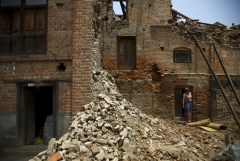
Many buildings already weakened by a much bigger quake last month were brought down.
The earthquake was centred 68 kilometres (42 miles) west of the town of Namche Bazaar, close to Mount Everest and the border with Tibet, the US Geological Survey said. It could be felt as far away as northern India and Bangladesh.
Buildings swayed in New Delhi, sending office workers scurrying on to the streets. Residents in the Indian town of Siliguri, near the border with Nepal, said chunks of concrete fell off one or two buildings.
Five people were killed in Indian states bordering Nepal - one in Uttar Pradesh and four in Bihar, officials said, and Chinese media reported one person died in Tibet after rocks fell on a car.
Nepal is still picking up the pieces from the devastation caused by last month's 7.8-magnitude earthquake, the country's worst in more than 80 years, which killed at least 8,046 people and injured more than 17,800.
Hundreds of thousands of buildings, including many ancient sites, were destroyed and many more damaged.
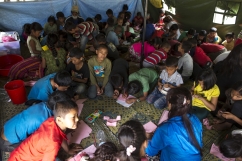
Tearfund spokeswoman Oenone Chadburn told Christian Today that it had not yet been able to contact its partner workers in the field. However, she said that in the capital Kathmandu there had been panic. "People are very scared, choosing to stay out in the streets," she said. "It's been doubly traumatic for them and we need to pray and support them." She said that many were sheltering from the early monsoon rains under tarpaulins.
Chadburn said that early signs were that the earthquake had struck areas that had already been hit, meaning that buildings that were previously damaged had collapsed or would need to be demolished.
Christian Aid emergency programme officer Yeeshu Shukla, already in Nepal to help co-ordinate relief efforts after the first earthquake, was in the Sindhupalchowk region some 40 miles away when the building he was in began shaking.
"For a moment, I felt that the building I was in would come down," he said. "We rushed out. Everyone was out on the street, some of them panicking, with mothers screaming, looking for their children. There were four or five severe after-shocks and some buildings collapsed.
"Travelling later towards Kathmandu the roads were lined with people too scared to re-enter buildings, with heaps of rubble where some had structures had collapsed.
"Now the race is to get relief through to the worst hit areas – clothing and other essentials. There is a shortage of drivers, however, many of whom have returned to their homes to be with their families."
Nick Guttmann, Christian Aid's Head of Humanitarian had just arrived in the country to monitor the progress of Christian Aid's initial relief efforts.
He was visiting a partner agency in Kathmandu before visiting a distribution point when a slight tremor ran through the building. Everyone stood up, and then everything began moving.
"Outside, the ground looked like it was rippling," he said. "We didn't know where to go and stayed under some corrugated iron."
An hour after the earthquake, he said, "people were walking round the streets, not knowing what to do, I heard one woman ask 'What is happening to Nepal?'"
In Kathmandu, people panicked and rushed outdoors when the tremors began around 12.30, Reuters witnesses said. The quake was followed by at least half a dozen aftershocks, including one as big as 6.3.
Parents could be seen clutching children tightly, and hundreds of people were frantically trying to call relatives on their mobile phones.
Shopkeepers closed their shops and the streets were jammed with people rushing to check on their families.
"I'm heading straight home," said Bishal Rai, a man in his 20s, who said he was trying to contact his family in the north of the capital.
ASSESSING DAMAGE
Medics and volunteers formed a human chain at a Kathmandu hospital to keep a path open for ambulances.
A volunteer at the hospital said five or six injured people had been brought in, two on stretchers. So far, few ambulances had arrived, he said.
Some aid and rescue teams, which were on their way back from Nepal, were considering whether to return to help.
"There is a huge concern for the people who may be living in structures that did not prove earthquake sound," said De Wojtek Wilk, CEO of the Polish Center for International Aid.
Wilk said his last team of medics were currently on their way back from Nepal, but he was wondering whether to send them back on a return flight.
Indian Air Force spokesman Simranpal Singh Birdi said one MiG 17 aircraft stationed in Kathmandu has been sent to Namche Bazaar to assess the damage.
LEFT SHAKEN
At least four people were killed in Chautara town in Sindhupalchowk district, north of the Nepali capital Kathmandu, a spokesman for the International Organization for Migration said.
The new earthquake also triggered at least three big landslides in the district, which suffered the heaviest death toll in last month's quake.
A district official there said 12 people had been injured.
"The latest earthquake has left us shaken. I am still trembling," said the official, Diwakar Koirala, when reached soon after the quake.
Rhita Doma Sherpa, a nurse with the Mountain Medicine Center in Namche Bazaar, near the epicentre, said the quake caused cracks in several buildings, including a school, but she had not seen major damage.
"It was lunchtime. All the kids were outside. Thank God," she said.
Additional reporting by Reuters.