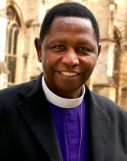
Archbishop Janani Luwum was the head of the Anglican Church in Uganda under the gangster rule of Idi Amin. He was a firm opponent of Amin's excesses and paid the ultimate price for it, martyred by regime thugs on Amin's orders.
He died in 1977 on either February 16 – the day observed in his memory in Uganda – or 17, the day on which he's commemorated in the Anglican Communion.
His story is an example of the cost of discipleship and has been an inspiration for nearly 40 years.
Born in 1922, Janani became a Christian in 1948 and went to theological college the following year. He was ordained in 1954 and became a bishop in 1969. Five years later he was appointed Archbishop of the Metropolitan Province of Uganda, Rwanda, Burundi and Boga (in Zaire).
The times were exceedingly troubled. The country was plagued by tribalism and the post-indepence president, Milton Obote, was overthrown by General Idi Amin in 1971. His regime was fiercely repressive, with thousands of people shot and imprisoned. Around 55,000 Ugandan Asians, mainly small shopkeepers from India and Pakistan, were expelled. An army rebellion led to thousands of arbitrary executions.
The train of events leading to Janani's death began with a sermon by Bishop Festo Kivengere before government officials on January 30, in which he denounced the killings. The following Saturdary Janani's home was raided. After he visited Amin to protest at the killings and 'disappearances', he and two Cabinet ministers were arrested and held for military trial.
On February 16 they were paraded at a rally in Kampala and Janani was accused of planning to stage a coup. They were driven off in a Land Rover to an interrogation centre and never seen alive again. A government statement said one of the prisoners had tried to escape and their car had collided with another vehicle, killing them all. When their relatives saw the bodies, however, they were riddled with bullets. According to some witnesses they were taken to an army barracks, beaten and shot.
Janani showed great courage in the face of death. He told Kivengere before his protest: "They are going to kill me. I am not afraid." On another occasion he said, "I am prepared to die in the army of Jesus."
He was given a memorial in Westminster Abbey in 1998. Among those he influenced during his lifetime was the Archbishop of York, John Sentamu, who met him when he was posted to Gulu town as a magistrate. Janani told him to use his position to bring justice to the country.
"We must be Christ to his people," Sentamu said Janani told him. "Take up their cases."