The Pope in Africa has given passionate witness of the kind exemplified in the original Prayer of St Francis. He has pushed his radical agenda once again on peace, love, faith and hope. If the climate change talks in Paris this week are a success, he will deserve a share of the credit.
"Yet again he's not put a foot wrong," Austen Ivereigh, author of The Great Reformer, an authoritative biography of Pope Francis, told Christian Today. "What has struck me during the visit is that here is a man who identifies so clearly with the priorities of the developing world. He has just been so focused on the concerns of Africans and the African Church."
In Kenya, Uganda and Central African Republic he has reiterated the causes he has made priorities of his papacy: environment, poverty, peace and reconciliation, relations with other faiths. And clearly thinking of the local context, he has in Africa been eloquent about corruption, the temptations of which he likened to the sweetness of sugar. This was in Nairobi, where he did what is becoming a habit – he ditched a prepared speech to urge good governance and also warn against tribalism, drugs and fanatical ideologies.
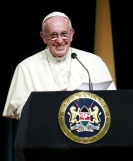
Speaking in front of Kenya's President Uhuru Kenyatta, whose government has faced allegations of corruption, Pope Francis admitted: "Also in the Vatican there are cases of corruption. Please, don't develop that taste for that sugar which is called corruption."
He endeared himself also by visiting Kangemi in Nairobi, an area of deep poverty which few visiting dignitaries care to be seen in, as befitting his Argentine nickname "the slum bishop".
His message on the environemnt was equally strong. Warning of a "grave environment crisis facing our world", he said special interests must not be allowed to get in the way of any attempt to curb fossil fuel emissions in Paris this week, a meeting that he has been taking aim at from the publication of his encyclical on the issue earlier this year onwards. Once more this was a topic that resonated with his audience in Africa where the devastating effects of global warming are all too apparent to those who live there.
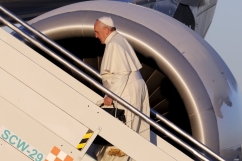
This was the Pope's first ever visit to Africa and his 11th foreign trip since becoming Pope three years ago.
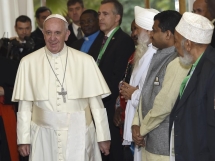
Even in the Central African Republic, riven by interreligious war between the majority Christians and minority Muslims, he brought a message of reconciliation, visiting a mosque and stating he was more afraid of mosquito bites than the security risks which had so worried his advisers.
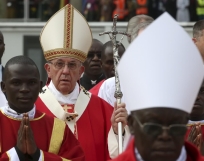
In Uganda, he revelled in the joyous, almost Pentecostal-style of worship of the church there, a contrast to the more traditional Kenyan services. Catholicism is growing fast across Africa. So are evangelical and Pentecostal churches but far from being worried about this, Pope Francis seems almost to welcome it. Unity was a recurrent theme in his addresses in Africa.
Not everyone will have been left happy. The difficult issues of HIV/Aids and of homosexuality were not prominent as some campaigners had wanted. In the mass at the sanctuary of the Ugandan martyrs, slain by an abusive, 19th century king after they refused to deny their Christian faith, he left out a part of his prepared homily that referred to "what the Gospel does not allow", a message the martyrs had preached to the king. This was thought to have been a reference to homosexual acts. It was unclear why he dropped the passage, but there will be disappointment that he failed to speak out, publicly at least, against Uganda's draconian anti-gay laws.
In visiting Central African Republic he showed his significant courage as the country is in the throes of a violent and murderous civil and religious war. He is the first Pope in recent years to visit a nation in such a state. Declaring his intention of being an "apostle of hope", he visited a refugee camp where up to 4,000 of the one million displaced people live. Today, Monday, he will visit a mosque. He called for harmony. The President, Catherine Samba-Panza, responding with powerful and moving words to his visit. She thanked him for coming despite "real or exaggerated" security threats. She said: "The greatest thing that your stay can bring us is the prayer that the demons of division, of hate and self-destruction might be exorcised and definitively chased away from our lands."
Dubbed, for obvious reasons, the "Pope of hope", this great and holy man has proved once again he is an agent of change.