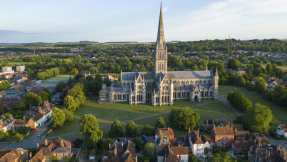
For centuries, abbeys and monasteries provided weary travellers and pilgrims with succour and refuge on often dangerous and fraught journeys. Now, according to a new survey from Monastaries.com, a specialist accommodation provider, travelling women are rediscovering these ancient refuges in a still dangerous modern world.
Their recent research found that 88% of women feel somewhat unsafe when travelling solo across the UK and Europe. Despite this, the number of solo female travellers outnumbers male travellers 67% to 37%.
"Women are increasingly setting off on their own adventures, with 27% of British women saying they are considering a holiday alone. Eighty-one per cent of solo female travellers are over 45 years old," Lily Smith, a travel expert from Monasteries.com, said.
"There are many factors that may have influenced this statistic - a newfound confidence as you get older, children leaving home, divorce, or just a desire to experience new things."
However, for many women, their safety is an important consideration, despite traditional accommodation falling short of their expectations. Only a minority of those surveyed felt safe staying alone in a holiday property rental or a large hotel, at 37% and 35% respectively.
"For that reason, many women are surprised but delighted to discover they are able to stay in monasteries and convents both here in the UK and in many countries across Europe," Ms Smith said.
"That might be a surprise to some people but, remember, monasteries have offered sanctuary to pilgrims and travellers for centuries, with a vow of 'hospitality' a feature for many religious orders."
Ms Smith said that despite what people might expect, accommodation at sites such as abbeys or monasteries comes with only a few more restrictions than standard providers, yet can offer a far more welcoming and unique experience—nor are they limited to people from a religious background.
"Often, the only major restriction might be a curfew, which is typically between 10pm and midnight. For many solo female travellers, however, the safety this offers may actually prove an attraction," Ms Smith said.
"Perhaps contrary to expectation, there is no requirement for visitors to be of a religious background. Properties are available to any guest, female or male, who is respectful of the surroundings, the lifestyle and the monks or nuns."
Even better, many of them are situated in breathtaking locations and are pleasingly affordable.
"The good news is that abbeys and convents are likely to be centrally located, often close to historical churches or religious landmarks and in cities such as Rome with a clear religious connection," she said.
"Furthermore, the abbeys, convents and monasteries at Monasteries.com, for example, start from as little as €40 a night and provide low-cost city centre stays in some of Europe's most-visited cities...for an increasing number of women travellers, explaining the security and ease of monasteries, convents and abbeys is like preaching to the choir."