30 May marks the anniversary of the execution of the last Lollard martyr before the creation of the Church of England. Thomas Harding, a humble man from the Chilterns, was found reading books by William Tyndale when they were still regarded as heretical. This is the story ...
The Lollards
The Lollards were England’s first evangelical movement, shaped by the reforming teaching of John Wycliffe. They wanted Scripture in the language of the people. They gathered for prayer and Bible reading in homes and believed that the authority of the Bible stood above the claims of the Church. Their convictions were simple and deeply biblical: Christ should be known directly through Scripture, worship should not be burdened with superstition, and the gospel should be heard in English rather than Latin. These were the very instincts that would later reappear, more powerfully and widely, in the work of William Tyndale.
The Chiltern Lollards
Lollard influence was especially strong in the Chilterns, the wooded countryside between London and Oxford, where believers were repeatedly investigated and punished. There were persecutions there in 1414, 1462, and 1511, long before Tyndale’s New Testament appeared in print. In many ways, the Chiltern Lollards kept alive a hunger for the Scriptures that Tyndale would later answer with a translation shaped by the Greek text and written in clear, living English. Tyndale did not invent English evangelical faith, but he did give it a fuller and more readable Bible.
In 1511, William Smith, Bishop of Lincoln, launched an inquiry into heresy in south Buckinghamshire from the former bishop’s palace at Wooburn. Some Lollards in Amersham were questioned and spoke against idolatry and superstition. Some were punished with forced penance or imprisonment, while others faced death unless they recanted. This was the world into which Tyndale’s later books would arrive.
Thomas Harding’s story
Thomas Harding was one of the Lollards associated with Amersham. His story appears in Foxe’s Book of Martyrs and in local tradition, and it reflects the survival of Lollard faith into the age just before the English Reformation. Harding, like others, had once recanted, but by 1521 he had returned to, or perhaps never left, his old convictions. He was summoned again before an ecclesiastical court under Bishop John Longland. Six Lollards, five men and one woman, were sentenced to death, and Harding escaped execution by recanting again. He was then confined to the parish of Amersham, but after the executions in 1522 he moved to the nearby small town of Chesham, where he kept a smallholding.
Tyndale’s books
By this time, William Tyndale had become the great new voice of English Scripture. His New Testament, translated from the Greek and printed in Germany, was first smuggled into England in 1526. Compared with Wycliffe’s earlier Bible, Tyndale’s translation was more direct, more idiomatic, and more accessible to ordinary readers. It quickly became treasured by the Lollards because it put the words of the New Testament into clear English that could be read, taught, and believed.
Tyndale’s influence went beyond the New Testament itself. His other writings, including The Obedience of a Christian Man and The Practice of Prelates, showed why English Bible reading was inseparable from reform in doctrine and church life. He argued for the authority of Scripture, the centrality of Christ, and the need for obedience to God above human power. For people like Harding, Tyndale was not just a translator; he was a theological guide and a herald of a coming change.
Harding’s execution
Around Easter 1532, Thomas Harding, then about 60 years old, was found sitting by a stile near Hodd’s Wood reading one of Tyndale’s books, The Obedience of a Christian Man. That was enough to bring arrest. When Harding and his wife Alyce’s home was searched, officials found other books hidden under the floorboards, including Tyndale’s 1526 New Testament and The Practice of Prelates. At the time, it was considered heresy to read such forbidden material.
Harding was taken to Wooburn and questioned by the bishop and by Rowland Messenger, the vicar of High Wycombe. The charges against him were that he read the New Testament in English, denied transubstantiation by treating the bread and wine as symbolic, rejected the veneration of images, and spoke against pilgrimages as a means of gaining merit. In other words, he was an evangelical. Having already recanted twice, the authorities were less lenient this time.
On 30 May 1532, nearly 500 years ago, Harding was taken to Chesham and burned at White Hill as an example to others. He was chained to a stake, the fire was lit, and his death was intended to warn away anyone tempted by English Scripture. It is said that, as the fire was lit, someone in the crowd threw a piece of firewood at his head, which killed him instead and saved him from the flames, as a kind of mercy killing.
Legacy
Harding’s death came only two years before the Church of England was formed in 1534, and only seven years before Henry VIII authorised English Bibles in churches in 1539. The beliefs for which Harding died would soon become mainstream belief. Harding died at the end of one era, but in the shadow of another that Tyndale had heralded.
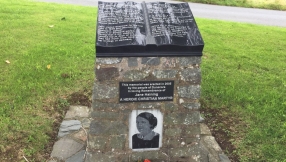
Today, there are memorials to Thomas Harding in Chesham, including a plaque near where he was arrested, a granite cross near St Mary’s parish church, and a commemorative stone on White Hill near the place of execution. A junior school also bears his name. He is not forgotten in the Chesham area, but is little known elsewhere. There is a self-guided Thomas Harding Walk which takes visitors to places connected to his life. On 19 April 2026, Chesham Museum remembered him with a costumed re-enactment of some of his final days, and local Chiltern folk singer David Darvell has written a song about him.
His story remains significant not only as the story of a local martyr, but also as a reminder that the English Bible did not arrive suddenly in one moment. It was embraced by a movement already wanting the Scriptures in English, but opposed by authorities who feared its dangers. It is sobering to recall that when William Tyndale’s New Testament came out 500 years ago, in 1526, it had to be smuggled into England, where people could still be persecuted and burned at the stake for possessing it. Today, we glibly take for granted that we can own multiple editions of the Bible and forget that, in the past, people put their lives at risk just to get one.