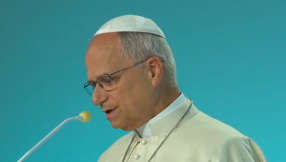
On 25 March Dame Sarah Mullally was enthroned as the Archbishop of Canterbury in Canterbury Cathedral. In her sermon the Archbishop declared:
‘In the Incarnation, we see God becoming one of us, and this gives me such hope for the church. In the ordinary and the extraordinary life of the church, we see God’s hand at work, the church rolling up its sleeves and getting stuck in where God is already at work, in the local and the global.
‘The church through the ordinary lives of its people continues to do so many extraordinary acts of love. God’s people, offering a listening ear, a word of encouragement or a prayer of healing, offering food, shelter, sanctuary and welcome in a world that so often seeks to divide us, tables to sit at, conversations to be shared, and being a simple loving presence, like the salt of the Earth, a light on the hill, the treasure of the kingdom, a church for the whole nation and for the world, which looks for ways of joining in with people of all faiths and of none in acts of service which will transform, a church which extends around the world with our sisters churches in the Anglican Communion, as part of the one holy, catholic and apostolic church to embody Christ’s love.
‘God is at work in the good news of the Gospel and in the hearts and lives of ordinary people who, like Mary, have the audacity to believe that with God we can do extraordinary things.’
This passage struck me because it is typical of the kind of description of the activity of the Church that we find time and again in the statements made by bishops and others responsible for talking about the work of the Church of England.
For example, an article in the Daily Telegraph published the day before the Archbishop’s enthronement reported on a poll showing that a majority of people believe the Church of England should lose its right to run state schools. The article quoted people who supported this idea and finally a ‘spokesperson for the Church of England’ who said:
‘At the heart of the Church’s purpose in the nation is Christian service. That’s what shapes our presence in national life, and it’s what continues to guide our work in neighbourhoods up and down England. Every day, churches across the country provide support that people rely on.
‘Church of England parishes support or run more than 31,000 social action projects, with 60 per cent of churches involved in food banks, alongside warm spaces, community cafés, lunch clubs, toddler groups, school and hospital chaplaincy, and the quiet pastoral care offered to anyone who walks through the door
‘Through our schools we invest in the education and flourishing of over a million children in different communities across England – irrespective of faith background
‘Thousands of volunteers and ministers respond to this calling to serve our communities and the common good, wherever people are and whatever they believe.’
What the two statements I have just quoted, and numerous others like them which I could have cited, implicitly offer is an apologetic for the Church of England based on all the good things that its members undertake that those in society as a whole will generally recognise as worthwhile.
I have no reason to doubt that those in the Church of England engage in all the good works described in the two statements I have quoted. I also accept that it is proper that those in the Church of England should do the things described for the simple reason that they are ways of fulfilling the second of the two great commandments given by God ‘You shall love your neighbour as yourself’ (Leviticus 19:18, Matthew 19:19, Romans 13:9). It is necessary that Christians in the Church of England do these things because, as James insists in his Epistle, faith has to be manifested in good works:
‘What does it profit, my brethren, if a man says he has faith but has not works? Can his faith save him? If a brother or sister is ill-clad and in lack of daily food, and one of you says to them, ‘Go in peace, be warmed and filled,’ without giving them the things needed for the body, what does it profit? So faith by itself, if it has no works, is dead’ (James 2: 14-17).
I further accept that if you are going to communicate the Christian faith in today’s world it cannot be presented in a disembodied fashion but has to be shown to be something that has positive effects in practice. This is because as Graham Tomlin explains in his book The Provocative Church:
‘… contemporary culture in the West (and far beyond, if the prophets of globalization are right) has become very wary of disembodied truth. Where truth is suspected of being a mere front for power games, what lies beneath the surface of truth becomes a critical issue. In other words, the connection between the truth claim, and the kind of living that emerges from it, comes under very close scrutiny. Is this truth just another bid for power and mastery over others, just like Fascism and Marxism were, the discredited ideologies of the 20th century? Evangelism that proclaims the gospel of truth yet pays little attention to the kind of community it creates or the quality of life of the people it shapes, is unlikely to be listened to for very long by those who have imbibed the postmodern suspicion of disembodied truth with their mother's milk.’
Given all this, why am I still uneasy about the kind of apologetic for the Church of England found in the Archbishop’s sermon and the quotation from the Church of England spokesperson above?
The answer is because if you look at the Church of England’s communications all that it ever seems to highlight is the good works that Christians do to improve the temporal well-being of their neighbours (plus the services it can offer to mark life events such as marriage, the birth of a child, or the death of a loved one).
It is right to highlight these things, but they are not the primary reason for the Church’s existence. The reason for this is that human beings were created for an eternal relationship with God (in the famous words of Augustine in his Confessions ‘You have made us for yourself and our hearts are restless until they find their rest in you’) and no amount of improvement or amelioration of people’s lives in this world will enable them to achieve this end.
The distinctive truth to which the Christian faith, and only the Christian faith, bears witness is that this supernatural end is, in fact, not something that human beings can ever achieve for themselves, but that God himself through his Son Jesus Christ has made it possible for them to do so.
CS Lewis conveys this truth brilliantly in his famous children’s novel The Lion, the Witch and the Wardrobe. In this book the great lion Aslan, who is the central supernatural figure in the novel, explains why he has come back to life after having let himself be killed by the evil White Witch on a stone table to save Edmund, one of the four children who are the heroes of the story.
Edmund’s sister, Susan, asks ‘What does it all mean?’ and Aslan’s reply is:
‘It means that though the witch knew the Deep Magic there was a magic deeper still which she did not know. Her knowledge goes back only to the dawn of time. But if she could have looked a little further back, into the stillness and the darkness before Time dawned, she would have read there a different incantation. She would have known that when a willing victim who had committed no treachery was killed in a traitor's stead, the Table would crack and Death itself would start working backward.’
Lewis describes here what happened at the first Easter. The Bible and our own experience tell us that we are all traitors against God. We have betrayed God by rebelling against his good laws written in our hearts and in the pages of the Bible. In consequence, the ‘deep magic,’ the law of consequences that God has established, means that we die in soul and body. Our relationship with God is broken and we are subject to physical death.
However, that is not the end of the story. God’s eternal plan, his ‘deeper magic’ has been to do something about this, and this plan was fulfilled when Jesus, God’s eternal and incarnate Son, who, unlike us, had done no wrong, voluntarily took our death upon himself when he died on the cross on Good Friday. This act of willing divine self-sacrifice broke the power of death, as shown by Jesus’ resurrection from the dead on the first Easter day, and this means that all who believe in Jesus have a sure hope that after they die they will rise with him to the new life of God’s eternal kingdom and thus fulfil the purpose for which they were created.
Where the Church comes into the picture is that it is God’s instrument to enable human beings to receive the benefits of what God has done for them through Jesus Christ.
To understand this point it is helpful to consider three key statements by Jesus contained in John’s Gospel.
The first is John 3:16: ‘For God so loved the world that he gave his only Son, that whoever believes in him shall not perish but have eternal life.’
The starting point for receiving eternal life is hearing and accepting the good news that God has made eternal life available in the way that I have described above. However, as Paul notes in Romans 10, to believe the good news, we must have heard it, and we can only have heard it if someone has preached it:
‘How then will they call on him in whom they have not believed? And how are they to believe in him of whom they have never heard? And how are they to hear without someone preaching?’ (Romans 10:14).
Because this is so, the first task of the Church is to preach the gospel, or in other words to bear witness to what God has done for the world in Jesus Christ so that people will have the opportunity to believe it. That is why in Acts 1:8 Jesus tells his first disciples (and all who were to follow in their footsteps): ‘You shall be my witnesses in Jerusalem, and in all Judaea and Samaria and to the end of the earth.’
The second passage in John is John 3:3-5 in which Jesus tells Nicodemus:
‘Truly, truly, I say to you, unless one is born anew, he cannot see the kingdom of God.’ Nicodemus said to him, ‘How can a man be born when he is old? Can he enter a second time into his mother’s womb and be born?’ Jesus answered, ‘Truly, truly, I say to you, unless one is born of water and the Spirit, he cannot enter the kingdom of God.’
The birth to new life to which Jesus refers here is achieved sacramentally through baptism, the rite in which we are enabled to participate through the Spirit in Jesus’ death and resurrection. As Paul writes in Romans 6:4 ‘We were buried therefore with him by baptism into death, so that as Christ was raised from the dead by the glory of the Father, we too might walk in newness of life.’
It is important to note that according to Paul people do not baptise themselves. People are baptised by others. It is because this is so that the command given by Jesus in the great commission in Matthew 28 :19 is that his disciples baptise ‘in the name of the Father, of the Son and of the Holy Spirit’ and this is what the Church has done ever since the Day of Pentecost (Acts 2:41).
The third passage in John is the saying of Jesus in John 6:54-55 ‘He who eats my flesh and drinks my blood has eternal life, and I will raise him up at the last day. For my flesh is food indeed, and my blood is drink indeed.’ This eating and drinking takes place sacramentally as Christians obey Jesus’ command at the Last Supper (Matthew 26:26-29, Mark 14:22-35, Luke 22:19-24) and receive bread and wine at Holy Communion as a means of receiving in spiritual form the body and blood of Christ which were broken and shed for them on the Cross.
Preaching and the celebration of the two sacraments instituted by Jesus are thus the key tasks of the Church because they are the God-given means by which sinners are supernaturally saved by God for eternity. The primary gift the Church gives to the world is undertaking these tasks and those who speak for the Church need to be clear and forthright in saying so because no one else will.