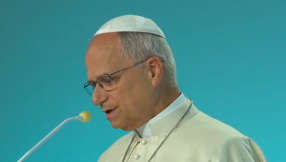
The recent visit by the new Archbishop of Canterbury, Sarah Mullaly, to see Pope Leo XIV in Rome is a reminder of the success of the ecumenical movement. Until the second half of the twentieth century the division between the Church of England and the Roman Catholic Church which opened at the Reformation would have made such a visit impossible.
However, the growth of the ecumenical movement during the twentieth century has resulted in such a visit being not only possible, but even unremarkable. It is now no big deal that the Archbishop of Canterbury has been to see the Pope.
For sixteen years I was involved in the ecumenical work of the Church of England at the national and international levels. In this article I shall draw upon this experience and explain the theological basis of the ecumenical movement and the challenge facing the ecumenical movement today because of new divisions over issues concerning human sexuality.
The theological basis for ecumenism
Ecumenical activity is activity undertaken by Christians which seeks to make manifest the unity between them that is a result of the saving work of God in the death and resurrection of Jesus Christ.
In verses 13-22 of the second chapter of his letter to the Ephesians Paul reminds them that those who have been saved by God through Christ’s resurrection have also been formed through Christ’s death into a new and united community - a community in which the division between Jews and Gentiles has been overcome and in which all human beings can be citizens of God’s kingdom, members of God’s family, and the holy temple in which God dwells through his Spirit:
‘But now in Christ Jesus you who once were far off have been brought near in the blood of Christ. For he is our peace, who has made us both one, and has broken down the dividing wall of hostility, by abolishing in his flesh the law of commandments and ordinances, that he might create in himself one new man in place of the two, so making peace, and might reconcile us both to God in one body through the cross, thereby bringing the hostility to an end. And he came and preached peace to you who were far off and peace to those who were near; or through him we both have access in one Spirit to the Father.
'So, then you are no longer strangers and sojourners, but you are fellow citizens with the saints and members of the household of God, built upon the foundation of the apostles and prophets, Christ Jesus himself being the cornerstone, in whom the whole structure is joined together and grows into a holy temple in the Lord; in whom you also are built into it for a dwelling place of God in the Spirit.’
In chapter 4 Paul further emphasises the unity of the community that has been created in this way. He tells the Ephesians that they should be ‘eager to maintain the unity of the Spirit in the bond of peace’ (4:3) and that the reason this is the case is because:
‘There is one body and one Spirit, just as you were called to the one hope that belongs to your call, one Lord, one faith, one baptism, one God and Father of us all, who is above all and through all and in all’ (4:4-6).
As John Stott writes in his commentary on Ephesians, what these verses tell us is that:
‘… there can only be one Christian family, only one Christian faith, hope and baptism, and only one Christian body, because there is only one God, Father, Son and Holy Spirit. You can no more multiply churches than you can multiply Gods. Is there only one God? Then he has only one church. Is the unity of God inviolable? Then so is the unity of the church. The unity of the church is as indestructible as the unity of God himself. It is no more possible to split the church than it is possible to split the Godhead.’
If the unity of the Church is as inviolable as the unity of God himself this raises the obvious question as to why Paul thinks it necessary to urge the Ephesians to be eager to maintain this unity. The answer to this question is that he is calling them to make visible in their relationships with each other the unity which has been created by God through the work of Christ.
Ecumenical thinking about the Church’s unity
All this being the case, the question arises as to what making visible the unity of the Church should mean in practice. During the twentieth century those involved in the ecumenical movement thought hard about this question and they produced what has come to be regarded as a classic answer to it in the World Council of Churches’ ‘New Delhi Statement on Unity’ which was issued in 1963.
This statement declares:
‘We believe that the unity which is both God’s will and his gift to his Church is being made visible as all in each place who are baptized into Jesus Christ and confess him as Lord and Saviour are brought by the Holy Spirit into one fully committed fellowship, holding the one apostolic faith, preaching the one Gospel, breaking the one bread, joining in common prayer, and having a corporate life reaching out in witness and service to all, and who at the same time are united with the whole Christian fellowship in all places and all ages in such wise that ministry and members are accepted by all, and that all can act and speak together as occasion requires for the tasks to which God calls his people.’
During the twentieth century those involved in ecumenism expended enormous amounts of time, energy and prayer in trying to make this vision of unity a reality, and their efforts were not in vain. As Paul Avis notes in his book Reshaping Ecumenical Theology, as a result of their efforts ‘the churches are closer to one another now in both faith and order than they have been for centuries.’
The vision of full visible unity set out in the New Delhi statement was never fully implemented. It remains a work in progress, but through the efforts of those involved in the ecumenical movement the New Delhi vision of unity came to be widely accepted, and serious steps were made towards trying to implement it.
The current challenge to unity
If the twentieth century saw significant ecumenical progress, what we have seen in the twenty first century is this progress stall and then begin to go backwards.
In Reshaping Ecumenical Theology Avis asks whether ecumenical progress can be expected to continue. His response is a warning:
‘One factor that could place a roadblock in the way is ethical disagreement, disagreement on what moral life is required by the churches of their members, and in particular, far more so than any other area, disagreement over questions of human sexuality. Where faith and order might make a high degree of communion possible, ethics might hold the churches apart.’
Avis’s warning is correct, but it does not go far enough. It is not only that disagreement over the ethics of human sexuality might hold the churches apart in the future, but that it is causing division between and within churches in the present. All Christian traditions have been and are being divided over ethical issues to do with human sexuality to the point where entirely new churches are now being formed as a result. Visible unity is heading backwards, just as it did when the Western Church divided at the time of the Reformation.
If we ask what the current disagreement is about, the answer is that it has two parts. It is a disagreement about whether it is right for people to have sexual relations with, or marry, people of their own sex and it is a disagreement about whether it is right for people to adopt a transgender identity as male, female, or non-binary, that does not correspond to their actual biological sex.
This disagreement is highlighted by two statements produced in 2017 by groups of Christians from across the churches who have opposite views on these matters. On the one side there is the statement ‘Christians United in support of LGBT+ inclusion in the Church’ which declares that it is right for people to do both these things and imperative for Christians to support those who do. On the other side there is the Nashville Statement that declares that not only are such things wrong, but that support for them is itself sinful.
In the face of the disagreement reflected in these statements we cannot say everything is ok in the sphere of ecumenism because of the ecumenical progress made in the past. We are, as Avis says, on a new ecumenical frontier, and we need to find a way forward in the face of the current divisions in the Church that will lead to a godly peace on this frontier, in the long term if not immediately.
What is the way forward for ecumenism today?
So, what would be the right way forward? There are three possibilities.
1. The churches could accept that it is right for people to have sexual relations with, or marry, people of their own sex, and affirm it is right for people to adopt a transgender identity as male, female, or non-binary, that does not correspond to their actual biological sex.
2. The churches could decide that such acceptance is contrary to the apostolic faith and should therefore be rejected.
3. The churches could decide that this is a matter on which different churches and Christians within churches should be free to differ.
There is, however, a variant of one, which implies that acceptance falls within the spectrum of legitimate Christian belief and practice.
Churches need to choose option two because of six key elements of the biblical witness that are highlighted in the Nashville Statement mentioned above. These six elements are:
- ‘that God has designed marriage to be a covenantal, sexual, procreative, lifelong union of one man and one woman, as husband and wife, and is meant to signify the covenant love between Christ and his bride the church;’
- ‘that God’s revealed will for all people is chastity outside of marriage and fidelity within marriage;’
- ‘that sin distorts sexual desires by directing them away from the marriage covenant and toward sexual immorality - a distortion that includes both heterosexual and homosexual immorality;’
- ‘that divinely ordained differences between male and female reflect God’s original creation design and are meant for human good and human flourishing;’
- ‘that the differences between male and female reproductive structures are integral to God’s design for self-conception as male or female;’
- ‘that physical anomalies or psychological conditions [do not] nullify the God-appointed link between biological sex and self-conception as male or female;’
If we are to continue to move forward towards the formation of a Church that is united in its adherence to the ‘one apostolic faith’ of the New Delhi statement (the ‘one faith’ of Ephesians 4:5), we have to affirm the truths contained in these six points just as much as we have to for example affirm the doctrine of the Trinity, or the doctrine of justification by faith. The apostolic faith is that which is taught to us in the prophetic and apostolic witness of the Old and New Testaments and these six elements summarise that witness in relation to the matters currently under dispute.
What are faithful Christians called to do in the present ecumenical situation?
In God’s good time the cultural pressures in Western society that are resulting in the current divisions within the Church over human sexuality will pass. The job of faithful Christians in the meantime is to uphold apostolic teaching themselves and to pass it on to subsequent generations, and to help others to do the same. They need to do this, even if it involves some form of internal differentiation within existing churches or, in extremis, the formation of new churches, so that when the current situation changes a clear witness to apostolic truth will still exist that can then be the foundation for the renewal of the Church and for the future development of that visible and godly unity that is God’s gift and calling to his people.