Distant but gigantic comets pose greater threat to Earth than asteroids, can wipe out mankind, scientists warn

For the past two decades, hundreds of giant comets have been discovered in our solar system near the outer planets. But they were dismissed as harmless to life on Earth by virtue of their sheer distance to our planet.

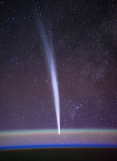
But now astronomers are saying these giant comets known as centaurs may not be harmless after all. In fact, just one of these comets is enough to destroy Earth if it hits our planet.

A team of astronomers from Armagh Observatory and the University of Buckingham has issued a warning that these massive comets, measuring 50 to 100 kilometres across, seriously threaten life on Earth, and are capable of wiping out the entire human race.

In the December issue of Astronomy & Geophysics (A&G), the team—composed of Professors Bill Napier and Duncan Steel of the University of Buckingham, Professor Mark Bailey of Armagh Observatory, and Dr. David Asher, also at Armagh—said these distant comets are actually greater hazards to Earth compared to closer asteroids.

Napier explained that the centaurs, which move around on unstable orbits crossing the paths of the massive outer planets Jupiter, Saturn, Uranus and Neptune, can occasionally be deflected towards Earth due to planetary gravitational fields.

"In the last three decades we have invested a lot of effort in tracking and analysing the risk of a collision between the Earth and an asteroid," the professor explained.

"Our work suggests we need to look beyond our immediate neighbourhood too, and look out beyond the orbit of Jupiter to find centaurs. If we are right, then these distant comets could be a serious hazard, and it's time to understand them better," he added.

Based on the researchers' estimates, a centaur can reach the inner solar system and be held towards the Earth's path once every 40,000 to 100,000 years.

Although the gigantic comets are likely to disintegrate when they reach Earth's atmosphere, their debris can still hit and bring destruction to our planet.

In fact, the researchers hypothesised that these giant comets led to the mass extinction of dinosaurs some 65 million years ago.


related articles
Mysterious metallic object crashing to Earth on Friday the 13th this month seen as sign of doom

Mysterious metallic object crashing to Earth on Friday the 13th this month seen as sign of doom

California \'UFO\' scare: No need to fear, it\'s just a Trident missile test, says U.S. Navy
California 'UFO' scare: No need to fear, it's just a Trident missile test, says U.S. Navy

California 'UFO' scare: No need to fear, it's just a Trident missile test, says U.S. Navy

Bringer of doom on Earth: Comets caused many mass extinctions over the past 260 million years, study finds

Bringer of doom on Earth: Comets caused many mass extinctions over the past 260 million years, study finds

Extraterrestrial life more likely to be found in planets close to each other, says study

Extraterrestrial life more likely to be found in planets close to each other, says study

News
Archbishop of Canterbury withdraws award given to Muslim cleric who praised Bin Laden

Reform leader Nigel Farage said the decision to award Hafiz Muhammad Tahir Mehmood Ashrafi was "astonishing". 

How the new General Synod could move beyond the present disagreement over same-sex relationships

How might the next Synod make progress in the next five years based on a recognition that there are those in the Church of England who hold fundamentally opposed positions on the matter? Is there a way of allowing both sides to achieve what they want? Martin Davie argues that the answer to this question is ‘Yes.’

No part of London should become a free speech, gospel exclusion zone

Soho is not exempt from freedom of speech and Christian expression. And Christians do not lose their fundamental freedoms when they cross an invisible boundary into a neighbourhood associated with a different worldview. The streets of London belong to all of us, writes Andrea Williams.

Church of England blessing same-sex relationships 'a bridge too far'

Earlier this year the Church silenced a group of former-homosexuals who wanted to tell of the change in their lives.