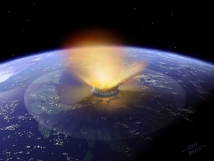
Most of us believe that a huge asteroid that hit Earth millions of years ago spelled doom for the dinosaurs that used to walk on our planet.
But now scientists are saying that we should not be too quick in blaming the space rock for the dinosaurs' extinction. A new study recently revealed that these giant reptiles were already on their way to extinction even before the asteroid struck Earth.
Researchers from the University of Bristol and the University of Reading, both in the United Kingdom, conducted a study which showed that dinosaur population was already on the decline long before the catastrophic six-mile-wide asteroid hit what is now the Gulf of Mexico, 66 million years ago.
"One of the things that has been long debated about dinosaur evolution is whether they were reigning strong right up until the time of the meteorite impact, or whether there was a slow, gradual decrease in [the emergence of new species] or an increase in extinction before that time," one of the researchers, Chris Venditti from the University of Reading, said in an article by The Guardian.
In a study published in the Proceedings of the National Academy of Sciences, the team described how they explored the rise and fall of dinosaur species over time using a new kind of statistical analysis based on large "family trees" of these reptiles.
These three large "family trees" are: the sauropods or the long-necked herbivores, the theropods or the flesh-eating beasts including the Tyrannosaurus Rex, and the ornithiscians, or the plant-eating, long-beaked species.
According to the study, dinosaur populations boomed during the late Triassic period, or about 220 million years ago. The rise in the number of these reptiles, however, stopped and reached a plateau some 140 million years ago.
The researchers further said that the period of decline began 90 million years ago, or 24 million years before the asteroid impact. At this point, dinosaur species were going extinct faster than new ones emerged.
"If they continued on that trajectory, even if that meteor didn't hit, they may well have been very species-poor in some millions of years or even have gone extinct all together," Venditti explained.