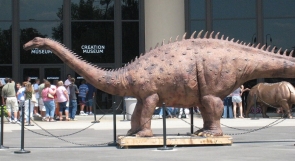
Advocates of the theory of evolution oftentimes use archaeological evidence such as fossils to prove that human beings came from apes. Little do they know that these same artefacts can be used to disprove their theory, and to all the more proclaim the Gospel Truth that God created life on Earth.
The Creation Evidence Museum in Glen Rose, Texas showcases several fossils that will be impossible to explain using the evolutionary theory, and which can be counted as scientific support for Creationism.
For instance, the Museum puts on display a handprint in limestone unearthed in the 1970s near Weatherford in Texas.
The fossil is believed to be from the Cretaceous Era, some 110 million years ago. If the artefact is dated correctly, this would mean that human-like creatures already existed on Earth much earlier than scientists who believe in evolution predicted.
Evolutionists could question the dating methods employed in estimating the age of the handprint, raising the possibility that it could be flawed.
However, another possible explanation is that the Earth is much younger than most scientists will admit.
Another object that will be difficult for evolution believers to explain is the specimen of a fossilised human finger, also showcased at the Creation Evidence Museum.
The archaeological evidence, found also in the 1970s in the Commanche Peak Limestone formation in Texas, is likewise believed to be from the Cretaceous Era.
This is puzzling because of the fact that flesh has been fossilised, when only bones usually undergo this process and survive for millenia as fossils.
One possible explanation is that the human finger was fossilised as a result of instant entombment in mud from a huge flood—similar to the Great Flood told in the Book of Genesis in the Holy Bible.
The so-called Alvis Delk Cretaceous Footprint, believed to have been left by an Acrocanthosaurus dinosaur, also poses a challenge to proponents of the Theory of Evolution.
The footprint suggests that human beings and dinosaurs co-existed on Earth, something that is very unlikely, according to some academics.
"Human footprints in geologically ancient strata would indeed call into doubt many conventional geological concepts," said James Stewart Monroe, a professor emeritus of Geology at Central Michigan University, as quoted by the God Reports blog.