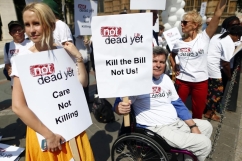
Jean Vanier, the Canadian theologian who founded L'Arche, a collection of Christian communities serving people with learning disabilities, has raised concerns about the pending Canadian assisted dying bill, warning that it lacks necessary safeguards.
"There should be a right for somebody who really wants to die," Vanier said, yet the bill that made its official debut in the Senate on Wednesday, lacks "certain safeguards" to protect vulnerable people.
"People could go through periods of just fatigue, depression, loneliness," he said. "So we mustn't go too quick to just say "there's a legal right". They also have a legal right to be walked with, accompanied, and helped."
Speaking to Canada's CBC radio, Vanier questioned the society from which the bill has emerged, as well as the bill itself.
"There's a fundamental sickness in our society," he said, identifying it as 'independence'.
"The 'something' in society that's going wrong when we [are] thinking all the time that people have to be perfectly independent, perfectly strong, where in reality, my God, we need each other."
Vanier did not deny that we are independent, rather that "we're also all interdependent", and that this might be discovered by moving "from the I to the we".
"We are all fragile, we all need help, and yet at the same time we all have strengths," he said.
Vanier began living in community with intellectually disabled people in 1964 before founding L'Arche, which now comprises 147 communities across five continents.
"People come to us maybe who are quite violent, who are in depression, but then they discover something. They discover that they're loved," he said.
"Lawmakers should also realise that the human being, we're born in weakness, and we die in weakness. And that we're all vulnerable. And that we all always need help. A society needs to encourage opening up our hearts to those who are weaker and more fragile."
When asked whether he would consider choosing to end his own life, he said he wouldn't, but admitted that he had never lived in intense pain.
"My own situation is that I lived in community, I'm with people, I know I'm loved, and I love people. I've comforted quite a lot of people in their deathbeds. And I can say here in L'Arche, we have become quite frequently friends of death. That can sound strange," he said.
"But when people die here, we have a big celebration, and we talk about them. We have photos of them. And we laugh and we cry, you know, because even on their deathbeds, we can hold their hands, look into their eyes, and say, 'I love you'."
The draft legislation, introduced by Justin Trudeau's Liberal government in April, would allow people with incurable illnesses or disabilities to end their lives with a medical professional's help, but stopped short of extending the right to minors and the mentally ill.
The Supreme Court of Canada overturned a ban on medical-assisted suicide last year and gave the new government until June 6 to come up with a law, adding Canada to the handful of Western countries that allow the practice.