Is the "curtain" of our universe slowly unravelling to reveal "neighbouring" universes?
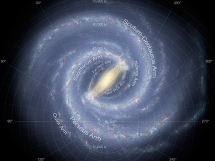
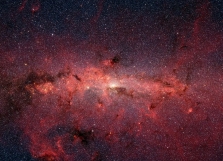
Astrophysicist Ranga-Ram Chary recently analysed data from the European Space Agency (ESA)'s Planck telescope and discovered mysterious bright spots at the edge of the Milky Way galaxy.
These spots, Chary concluded, may be pieces of evidence that can support the existence of alternate or even parallel universes.
These neighbouring universes may already be "leaking" into our own, the space researcher said.
"Our universe may simply be a region within an eternally inflating super-region," Chary said in his study published on The Astrophysical Journal.
The mysterious glow were particularly spotted by the scientist while mapping the so-called "cosmic microwave background," which is the light left over from the early universe.
He examined data during the period after the Big Bang, which is estimated to have occurred more than 13 billion years ago.
"Many other regions beyond our observable universe would exist, with each such region governed by a different set of physical parameters than the ones we have measured for our universe," Chary wrote in his study.
Chary's conclusion nevertheless will be difficult to verify, since the Planck telescope provides very limited data for further study.
According to an article on The New Scientist, however, Chary's conclusion should be possible if modern cosmological theories will be taken into account. These theories consider the Milky Way as one "bubble" among the many universes in outer space.
The unravelling of a "multiverse" is also possible due to cosmic inflation, or "the widely accepted idea that that the early universe expanded exponentially in the slimmest fraction of a second after the big bang."
"I would say most versions of inflation in fact lead to eternal inflation, producing a number of pocket universes," Alan Guth of the Massachusetts Institute of Technology was quoted by The New Scientist as saying.