Will approaching asteroid come dangerously close to Earth on March 5? Astronomers still unsure

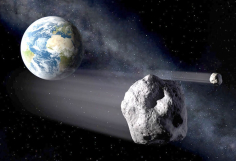
Graphic indicates the cloud of possible locations asteroid 2013 TX68 will be in at the time of its closest approach to Earth during its safe flyby of our planet on March 5. (NASA/JPL-Caltech)

An asteroid is currently approaching our planet, but space scientists are struggling to predict just how close it will get to Earth.

On March 5, Asteroid 2013 TX68 is projected to swing by our planet. The National Aeronautics and Space Administration (NASA) earlier said the asteroid will pass at a safe distance from Earth: 9 million miles (14 million km), or 35 times farther than the moon.

There is, however, a possibility that it will come dangerous close to Earth, specifically as near as 11,000 miles (17,000 km) to our planet. At this distance, the space object will be about half the altitude of orbiting geosynchronous satellites, although it is not expected to cause damage to any of the existing satellites.

Advanced technologies already exist to observe approaching space objects like Asteroid 2013 TX68, so one may wonder why there is so much uncertainty about this approaching rock.

Patrick Taylor, an asteroid scientist at Arecibo Observatory in Puerto Rico, attributed this to a general lack of data about the asteroid. This, he said, is primarily due to the fact that it is approaching the Earth from the direction of the sun, making it too bright to observe.

"On the day of the flyby, it should brighten dramatically as it moves away from the sun and hopefully one of the large asteroid survey programmes that scan the sky every night will pick it up again," Taylor told The National Geographic.

He said the asteroid was first spotted by the Catalina Sky Survey as early as 2013, but space scientists only had three days to observe and gather data about it before the space object passed in front of the sun and was lost in glare.

"While astronomers could determine an orbit for the asteroid, there was some uncertainty in the orbital parameters [or its specific flight trajectory]," Taylor said.

He is nevertheless hopeful that astronomers will be able to get a good view of Asteroid 2013 TX68 soon, so that they can determine exactly how close it will get to our planet, how fast it rotates, how big it is, and what it's made of.

"New observations will reduce the uncertainties on the orbit tremendously and determine just how close the asteroid will pass Earth," he said.


related articles
Distant but gigantic comets pose greater threat to Earth than asteroids, can wipe out mankind, scientists warn

Distant but gigantic comets pose greater threat to Earth than asteroids, can wipe out mankind, scientists warn

NASA plans Earth defence against possible asteroid strike, forms new office to detect dangerous space objects

NASA plans Earth defence against possible asteroid strike, forms new office to detect dangerous space objects

Asteroid with \'weird orbit\' making return trip near Earth next month, and this time, it may get closer
Asteroid with 'weird orbit' making return trip near Earth next month, and this time, it may get closer

Asteroid with 'weird orbit' making return trip near Earth next month, and this time, it may get closer

News
Faith in the festive chaos: how you can sustain your family’s faith this Christmas

Anna Hawken, Parenting for Faith from BRF Ministries, has some helpful tips for families to connect with God in the midst of the "December tornado".

Half of Armenian archbishops have been thrown in jail

The Armenian government has been in conflict with the church for a number of years now.

Catholics in Mozambique caring for survivors of Jihadist violence

International attention on Mozambique is scarce.

New study uncovers why some people leave their childhood faith and others stay

A new analysis from the Pew Research Center suggests that decisions about faith are often made early in life — and once made, they tend to last.