Asteroid with 'weird orbit' making return trip near Earth next month, and this time, it may get closer

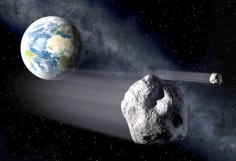
A relatively small asteroid about 100 feet (30 metres) in diameter, which flew past Earth two years ago at a safe distance of about 1.3 million miles (2 million km), will once again fly by our planet, only this time, it may get much closer.

According to the National Aeronautics and Space Administration (NASA)'s Jet Propulsion Laboratory, Asteroid 2013 TX68 can come as close as 11,000 miles (17,000 km) away from the Earth when it makes a second fly-by on March 5 this year.

It could, however, also go as far as 9 million miles (14 million km) away from our planet. Space scientists are having a hard time projecting what distance the asteroid will do its fly-by due to its "weird orbit."

"This asteroid's orbit is quite uncertain, and it will be hard to predict where to look for it," Paul Chodas, the director of NASA's Center for Near Earth Object Studies, explained in a statement posted on the space agency's website.

"There is a chance that the asteroid will be picked up by our asteroid search telescopes when it safely flies past us next month, providing us with data to more precisely define its orbit around the sun," he added.

In addition to this, Asteroid 2013 TX68 was only tracked for a short time after its discovery, making it hard for space scientists to determine its precise orbit around the sun.

The asteroid was first spotted on Oct. 6, 2013 by the NASA-funded Catalina Sky Survey as it approached our planet on the nighttime side. It passed the Earth's daytime side after its discovery and could no longer be observed.

Nevertheless, NASA assured that Asteroid 2013 TX68 will not bring about the apocalypse here on Earth. The space object actually has a 1-in-250-million odds of making closer contact with our planet in September 2017.

"The possibilities of collision on any of the three future flyby dates are far too small to be of any real concern. I fully expect any future observations to reduce the probability even more," Chodas said.


related articles
NASA\'s radar images of Christmas Eve asteroid show object 3,600 feet in length
NASA's radar images of Christmas Eve asteroid show object 3,600 feet in length

The National Aeronautics and Space Administration (NASA) released a holiday gift for space scientists and enthusiasts: radar images of the asteroid that made its closest approach to Earth on Christmas Eve.

Distant but gigantic comets pose greater threat to Earth than asteroids, can wipe out mankind, scientists warn

A team of astronomers from Armagh Observatory and the University of Buckingham warn that these massive comets called "centaurs," measuring 50 to 100 kilometres, seriously threaten life on Earth, and are capable of wiping out the entire human race.

The Holy Bible is right: International study shows water came from beneath the Earth

Affirming the Holy Bible's explanation on where water on Earth came from, members of the scientific community suggested that the precious liquid sprung from beneath our planet, not from the atmosphere or even asteroids as some scientists earlier suggested.

NASA plans Earth defence against possible asteroid strike, forms new office to detect dangerous space objects

The National Aeronautics and Space Administration (NASA) recently formed the Planetary Defense Coordination Office (PDCO), which is now tasked to oversee the space agency's efforts to detect and track near-earth objects (NEOs), primarily asteroids.

News
Historic Lancashire church awarded £614,000 towards restoration of Elizabethan ceiling

The money will go towards restoring its centuries-old Elizabethan ceiling and improve facilities for worshippers and the wider community.

Settler attacks in Taybeh leading to exodus of Christians

Taybeh has lost 10 per cent of its population in three years.

Questions raised about demolition of 19th century church in Manchester

Save Britain's Heritage has questioned the process behind the decision to call in the bulldozers.

Bishop raises plight of Christians caught in Sudanese civil war

Sudan has been in a state of civil war for most of its post-independence history.