More Americans back override of federal court rulings if state officials oppose them

More Americans, or one of three US voters, are now supporting the idea that states should have the right to ignore federal court rulings if their elected state officials disagree with them.

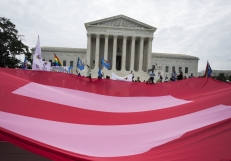
A poll was conducted by Rasmussen Reports after the US Supreme Courts issued decisions on Obamacare and same-sex marriage.

The survey was conducted among 1,000 likely voters from June 30 to July 1.

A total of 33 percent of the respondents said states should ignore federal court rulings, up from 24 percent in the same poll conducted last February.

Just over half, 52 percent, disagreed, down from 58 percent in the earlier survey. Fifteen percent remained undecided.

"Perhaps even more disturbing is that the voters who feel strongest about overriding the federal courts—Republicans and conservatives—are those who traditionally have been the most supportive of the Constitution and separation of powers," Rasmussen Reports said.

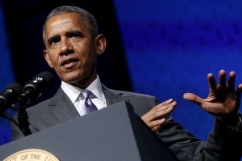
It claimed that under the Obama administration, "these voters have become increasingly suspicious and even hostile toward the federal government."

Fifty percent of Republican voters support the idea of states having the right to ignore federal court rulings compared to 22 percent among Democrat voters and 30 percent of voters who are not affiliated with either party.

The survey said 50 percent of conservative voters support this idea but just 27 percent among moderates and 15 percent among liberals.

A Rasmussen Reports poll on the US Supreme Court decision on same-sex marriage said 49 percent of likely US voters agreed with the decision while 45 percent opposed it.

In an earlier poll, 26 percent of votes said President Obama should have the right to ignore federal court rulings if they are standing in the way of actions he feels are important for the country. A total of 43 percent of Democrats agreed while 81 percent of Republicans and 67 percent of unaffiliated voters disagreed.


related articles
US Supreme Court set to rule on abortion restrictions in Texas

US Supreme Court set to rule on abortion restrictions in Texas

Victory for Obama as Supreme Court backs healthcare reforms

Victory for Obama as Supreme Court backs healthcare reforms

US Supreme Court rules in favor of gay marriage nationwide

US Supreme Court rules in favor of gay marriage nationwide

Justice Scalia: Supreme Court ruling on gay union a threat to democracy

Justice Scalia: Supreme Court ruling on gay union a threat to democracy

After its Obamacare ruling, Supreme Court becomes issue in US election

After its Obamacare ruling, Supreme Court becomes issue in US election

Obama gets image boost with 2 Supreme  Court decisions, Charleston church eulogy
Obama gets image boost with 2 Supreme Court decisions, Charleston church eulogy

Obama gets image boost with 2 Supreme Court decisions, Charleston church eulogy

News
Russia and Ukraine agree to temporary Orthodox Easter truce

In the Orthodox calendar, Easter falls one week after the date celebrated in western Europe.

Bishop urges people of Britain to stand up for Christian truth

It follows an earlier open letter addressed to King Charles, calling upon him to defend Christianity in line with his titles of Supreme Governor of the Church of England and "Defender of the Faith".

Fundraising Regulator reminds churches that collections are subject to code of practice

Churches can breach the code even when acting in good faith.

Religion is often left unspoken in the workplace despite widespread faith identity, research finds

Fifteen per cent of UK employees with a faith say they have experienced religious discrimination in the workplace.