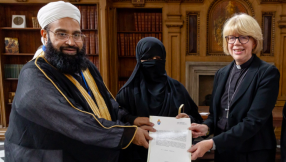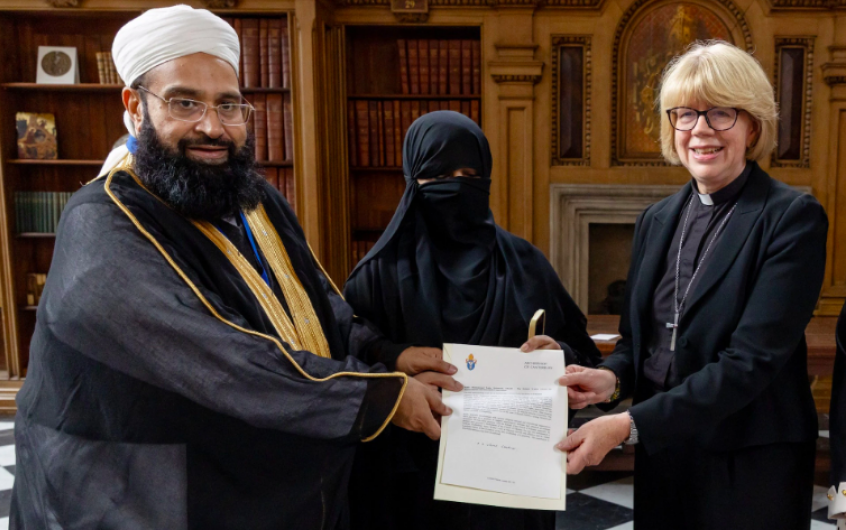
This is the picture that could lead to the political disestablishment of the Church of England.
On the 25th anniversary of the 9/11 Islamist terror attacks against the US, the Archbishop of Canterbury, Sarah Mullally, presents an award for reconciliation and interfaith cooperation to a Muslim cleric from Pakistan who is accused of praising the architect of the atrocities, Osama bin Laden.
In between the Archbishop and Hafiz Muhammad Tahir Mehmood Ashrafi, the recipient of the award, is the imam’s wife in a full Islamic niqab. The face of the first female Archbishop of Canterbury in the 1400-year history of the office is fully visible at the ceremony at Lambeth Palace, her official residence, but the face of the woman standing next to her is not.
The fact that the award has now been withdrawn cannot undo the damage. Ten years ago, Archbishop Mullally and the Church of England might have been able to put the mistake behind them. But the political climate is so much angrier now than it was even in 2016 when a divided country voted narrowly to leave the European Union.
Archbishop Mullally and her Lambeth Palace team have succeeded in grossly offending two groups of people among the British electorate. In the first group are people on the right of the political spectrum who are very concerned about the growth of Islamist influence in society.
In the second group are people who tend to be politically left-wing but are very concerned about the threats to women’s rights from transgender ideology. Harry Potter author JK Rowling is clearly a leading light among this group of people.
The picture above alienates both groups at once because they have overlapping concerns.
Politically, people in the first group would be inclined to support Reform UK, but they also include Conservatives such as Shadow Justice Secretary, Nick Timothy MP, who has been very critical of the Archbishop over the award.
He and Rebecca Paul MP, the Conservatives’ Shadow Culture Secretary, wrote to Archbishop Mullally on September 18.
“The Church of England teaches the equal dignity and worth of both men and women. Yet you presented the award alongside Mr Ashrafi’s wife, whose face was concealed by a niqab so that only her eyes were visible, and Lambeth Palace subsequently published that image," they wrote.
“This could appear to condone one of the most repressive manifestations of Islam, one that denies women basic freedoms over how they dress, whether they may show their faces and how they interact with others."
If a right-wing government is elected at the next General Election, due in 2029, the Church of England would be drinking in the last chance saloon. Its established status with 26 of its bishops having grace-and-favour seats in the House of Lords would be under grave threat.
Conservatives in the past have tended to defend the C of E’s established status out of loyalty to the Monarch as the Church’s Supreme Governor, despite often being annoyed by lefty pontifications from the bishops. But if Reform got into power, the Church could not rely on that kind of benevolent traditionalism. Reform would likely be much more radical in government than the Conservatives were from 2010 to 2024.
If Reform committed in its manifesto to replace the House of Lords with an elected second chamber and won power, the bishops would almost certainly be out. If there was a coalition government between Reform and the Conservatives, the C of E’s established status might survive but it would be fragile.
If there were a Labour-Green coalition next, the Church’s established status would be a lot safer because its bishops are so reliably left-wing in their interventions and voting habits in the Lords. But in such a divided and angry country, the Church’s privileged status would be far from secure.
Archbishop Mullally has another six years ahead of her, the Lord willing, until she hits the Church’s mandatory retirement age of 70 in 2032. If in that time she were to ditch neo-Marxist wokery and focus on getting across the core message of the Christian faith - eternal salvation from sin and judgement through the sin-bearing death of God’s one and only divine Son, Jesus Christ - and put pastoral care for the people in the parishes first, she might just be able to salvage the established Church.
Julian Mann, a former Church of England vicar, is an evangelical journalist based in Lancashire.