Is Islam a fundamentally violent religion? Listen to candidates for the Republican nomination and you might think so. Donald Trump notoriously said he wanted to ban all Muslims from the country, and he's not alone in his feelings about them: a Pew survey released last week found that a fifth of Americans thought that some religious teaching was responsible for violence, with most of them naming Islam in particular. And because Islamist extremism is so easily conflated with Islam, perhaps that's not surprising.
But is it right to link Islam with violence? Not according to one researcher, who's applied his skills in computerised text analysis to the Bible and the Qur'an.
Tom Anderson, founder of OdinText, put the Old and New Testaments and the Qur'an into a sophisticated analytical programme. He's more used to providing corporate clients with marketing information, but the question seemed like an interesting one in view of the current debate.
Anderson's programme looks for "sentiments and emotions" in the texts, but it's been tweaked to include specifically religious terms like God, Allah and Jesus. And he points out, with some satisfaction, that it took OdinText less than two minutes to read and analyze all three texts at once.
What did he find?
He was clear that they had "not set out to prove or disprove that Islam is more violent than other religions", and that they were very well aware that there was a lot more to Christianity, Judaism and Islam than just their sacred books.
However, they found that comparing the eight major emotions – joy, anticipation, anger, disgust, sadness, surprise, fear/anxiety and trust – the Old Testament is the 'angriest' and contains the least 'joy'.
They also found the Qur'an contains the most 'fear/anxiety' and 'trust/belief' issues.
They conclude that "A look into the verbatim text suggests that the content in the Qur'an is not more violent than its Judeo-Christian counterparts. In fact, of the three texts, the content in the Old Testament appears to be the most violent."
Killing and destruction are referenced slightly more often in the New Testament than in the Qur'an, but the Old Testament clearly leads – more than twice that of the Qur'an – in mentions of destruction and killing.
And while the New Testament is highest in 'love', the Qur'an is highest in the concept of 'mercy' or 'forgiveness'. The researchers acknowledge that this is because Allah is often described as "the Merciful", but say: "Some might dismiss this as a tag or title, but we believe it's meaningful because mercy was chosen above other attributes like 'Almighty' that are arguably more closely associated with deities."
There's also a key difference around the concept of 'faith/belief', with the Qur'an clearly ahead of the New Testament and the Old Testament a distant third.
Anderson concludes: "Those who have not read or are not fairly familiar with the content of all three texts may be surprised to learn that no, the Qur'an is not really more violent than its Judeo-Christian counterparts."
He adds: "Personally, I'll admit that I was a bit surprised that the concept of 'Mercy' was most prevalent in the Qur'an; I expected that the New Testament would rank highest there, as it did in the concept of 'Love'.
"Overall, the three texts rated similarly in terms of positive and negative sentiment, as well, but from an emotional read, the Qur'an and the New Testament also appear more similar to one another than either of them is to the significantly 'angrier' Old Testament."
Of course – as Anderson is the first to acknowledge – there's a lot more that could be said about about how the three texts actually work. Jews and Christians might want to ask not just how often violence and hatred appear in the Old Testament, but in what context they appear. Often (though not always) these stories are told not with approval, but with horror. But at the same time, if someone wants to go to the Old Testament as a way of justifying violence, there are plenty of examples to choose from.
However, one thing Anderson's work does is warn us against falling for lazy stereotypes. We can't condemn Muslims because their sacred text has violence in it when ours has even more.
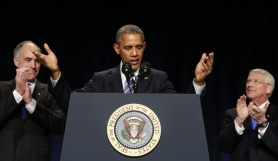
Last February, US President Barack Obama sparked a firestorm of criticism when he pointed out at a prayer breakfast in Washington that Christians had been guilty of atrocities in the name of religion as well as Muslims. His critics were outraged that he dared to compare the Crusades with the actions of Islamic State, but he was surely right – every faith can be perverted if its adherents choose the dark rather than the light.
Follow Mark Woods on Twitter: @RevMarkWoods